Thought I'd be quicker getting through all this but I'm still juggling my Top 10 of the decade - I have the books, just can't nail the order. In the meantime I figured I should return to regular programming and have a look at some of my highlights from this year.
BEST BOOKS NOT FROM 2019
The Friend by Sigrid Nunez (2018)
Devastatingly, achingly beautiful. I was in awe from the outset, marvelling at just how many profound things Nunez has to say about grief, writing and the bittersweetness of having a dog. In some ways, it reminded me (in spirit at least) of Magda Szabo's The Door or John Williams's Stoner. It's quiet and subtle but packs an emotional punch that likely measures on the Richter Scale. I kind of wish it hadn't ended.
Mad Shadows by Marie-Claire Blais (1959(
I stumbled across Blais during a random Facebook conversation and thought I should check her out. Pretty glad I did! The story of a horribly dysfunctional family devoid of any moral compass, Mad Shadows is a thoroughly nasty, unpleasant, misanthropic delight. I loved it! Thanks James Bradley and your strangely eclectic social feed.
Men In The Sun by Ghassan Khanafani (1978)
Leaving aside the controversies over Khanafani himself, Men In the Sun is an astounding collection of stories that get to the heart of Palestinian life in the 60s and 70s. Khanafani's greatest strength as a chronicler of the oppressed is his ability to convey the struggles without resorting to easy set pieces or tropes. The title story, in particular - almost novella length - is a masterpiece.
The Animal Gazer by Edgardo Franzosini (2015)
There's nothing like an obscure historical footnote to get me excited about a novel's subject. Here Franzosini zeroes in on Rembrandt Bugatti, probably most remembered (if at all) as brother to the motoring legend, but a strange and intriguing figure in his own right. Bugatti was a sculptor of considerable talent and some renown, who spent much time at the zoo watching the animals before sculpting them. Interspersed with photos of his sculptures, The Animal Gazer considers the ravages of war as seen through the eyes of a very gentle soul. When the Antwerp Zoo began killing their animals at the outbreak of World War 1, it was all too much for Bugatti, setting off his descent into the suicidal abyss. A sad and timely story.
Death of a Salesman by Arthur Miller(1949)
Is there a modern play so tense and soul crushing, yet so brilliant as this? Not a word wasted. About 15 years ago, I saw Brian Dennehy as Willy on Broadway and was totally gutted then, but had not actually read it until this year. Took me a few days to catch my breath.
THE SHELF OF SHAME: BOOKS I WISH I'D READ IN 2019
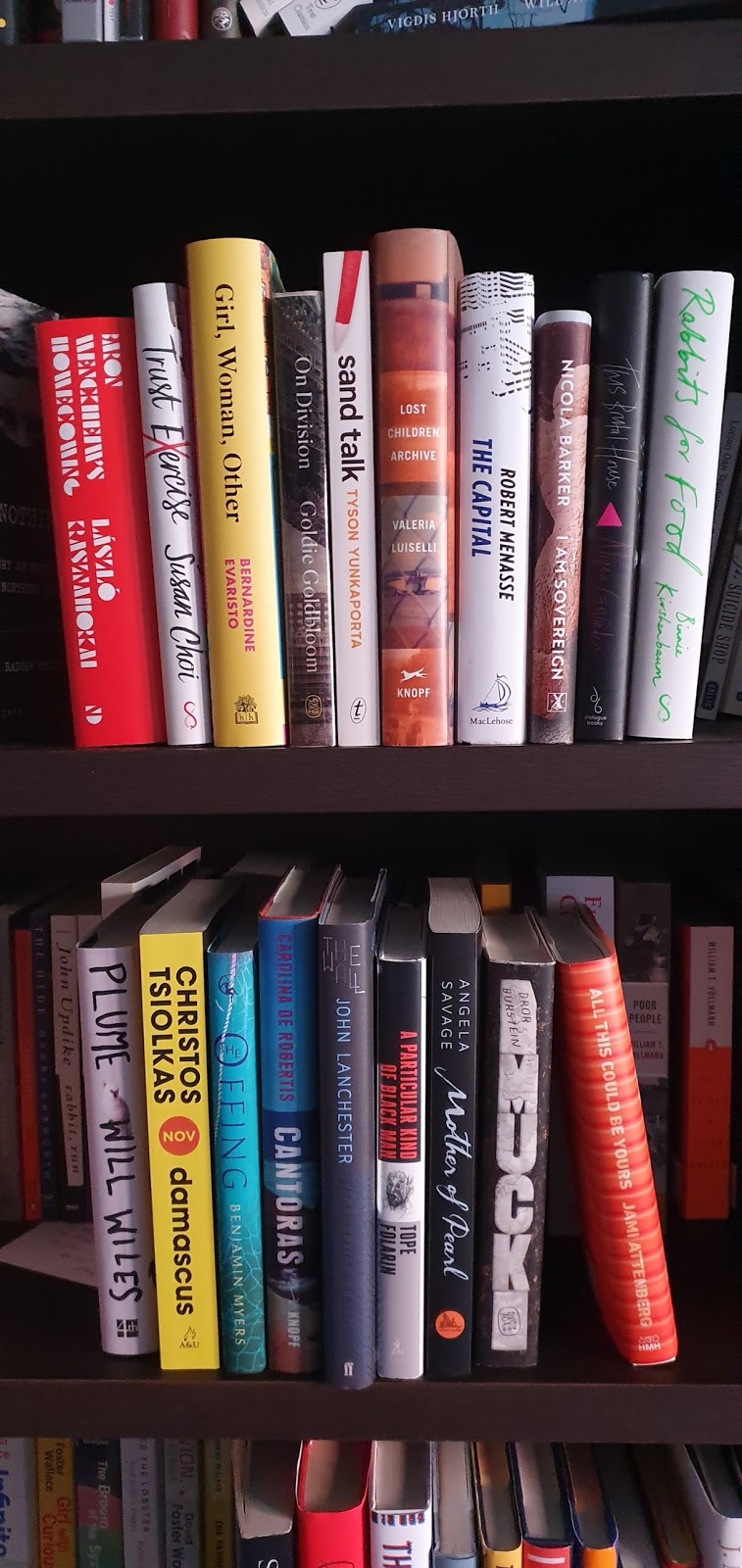
Not sure how the year got away from me but, well, here we are. Yet again, I'm left with a lumbering pile of books I bought with the very best of intentions. And, yes, I still hope to read them all (Krasznahorkai will be book number one for 2020). Alas, this is just the top third of the pile. Expect to see the others in newspaper photos of the collapsed tower that crushed me to death one day. Without further ado, I hang my head in deep, deep shame and present this picture:
5 BEST BOOK COVERS OF 2019
MOST ANTICIPATED BOOKS OF 2020
I don't think I've been this excited for a haul of forthcoming books in years! I barely know where to start, but I think I'd have to say the one that has me literally frothing at the mouth is Patrick Allington's Rise and Shine. If I gave you a list of all my favourite things in a book and asked you to write it and then you came back with something even better than I'd hoped, there's a good chance you'd give me Rise and Shine. No pressure or anything! Elizabeth Tan follows up the brilliant Rubik with Smart Ovens for Lonely People. I have an ARC on my shelf and it's taking all my strength not to drop everything else and read it. You might remember Timur Vermes's hilariously outrageous Look Who's Back from a couple of years back. Well, he might just have done it again with his madcap novel about a reality show set in a refugee camp, The Hungry and the Fat. Robbie Arnott's Flames was the best piece of Australian magical realism in living memory, and he's following it up with what promises to be the equally brilliant The Rain Heron. It's recently sold to FSG in the States so, yeah, it's going to be huge. Praise the book gods, Jenny Offill is back with Weather. If it's even a fraction as good as Dept of Speculation it might already be a contender for my book of the year. Speaking of, BOTY winner Garth Greenwell returns to the world of his sublime What Belongs To Us in Cleanliness. The buzz is insanely good so I'll be jumping on that the moment it comes out. Australia's finest cli-fi prophet, James Bradley, returns with Ghost Species and I can't help but feel what he has to say has never been more important. Seems like I was lamenting Charles Yu's recent silence only a few days ago and this morning I find out he has a new novel in the pipeline, Interior Chinatown. I'm a little wary, but Yu is so damn funny that I'm hoping a story that doesn't hugely appeal to me (it sounds a bit too much like Viet Thanh Nguyen's The Sympathizer) can be salvaged through its execution. If you dig a smart thriller, you'll likely be as excited as I am for JP Pomare's newy, In the Clearing which promises to fuck with your mind even more than Call Me Evie. And yes, in case you think I've forgotten, Hilary Mantel rounds out her trilogy with The Mirror and the Light which means I can finally get around to reading the other two.
I've also had the immense pleasure of reading an advance copy of The Slaughterman's Daughter by Yaniv Iczkovitz. It's an absolute romp - think the Russian classics with a shot of sly Yiddish humour - and expect me to be practically forcing you all to read it when it is released. The puffs have been streaming in from across the literary spectrum - Gary Shteyngart and George Szirtes both loved it. So will you.
THE SOUNDTRACK TO MY DOWNTIME: BEST ALBUMS OF 2019
I had high hopes for music in 2019. So many of my favourite bands were putting out new albums, some after a very long hiatus. Unfortunately, I was mostly disappointed. There were some pretty good records but most felt phoned in by bands in mid-to-late career slumps (I'm looking at you, Dragonforce). In previous years, I struggled to limit my list to 20. This year, I barely got to ten.
Morbid Stuff by PUP
PUP's self-titled debut still stands as my favourite album of the past ten years. It was the shot of adrenalin a very lacklustre music world needed. Their sophomore offering was pretty good but a bit dull. I wasn't sure what to expect of Morbvid Stuff. Was it too much to hope that they might rediscover that spark that made them so bloody exciting? Ah... yes. And then some. Jagged belter after jagged belter, PUP shred like there's no tomorrow. Dark, funny and insanely catchy this was far and above my album of the year.
Ghosteen by Nick Cave
At the risk of committing some kind of Australian musical high treason, I'm just going to put it out that and say I don't get the fuss about Nick Cave. That's not to say I haven't liked some of his albums, and I totally dig his position as a countercultural icon, but I certainly would not consider myself a fan. Well, way to go Nick. You've thoroughly confounded me now! I... I... kinda love Ghosteen, an album as confronting as it is lush and transcendent. Cave's poetry is at its finest, and I can't help but feel that this is some kind of microscopically detailed mapping of his soul in the aftermath of deep, personal tragedy. It might just be his best album. It is definitely his most pained.
Tommy and June by Tommy and June
The true identities of Tommy and June remain punk rock's worst kept secret, but whoever they are, these two managed to crank out the sweetest, most listenable folky, punky, poppy album of the year. Think Simon and Garfunkel meets, I dunno, Useless ID and Old Man Markley (*cough cough*). I keep going back and it never fails to make me smile, some five hundred listens later.
Love Keeps Kicking by Martha
Looking for the best jangly pop from a band you didn't know existed? Well, look no further! I was drawn to this album by it's totally silly, underwhelming artwork and was blown away by the infectious guitar pop I found. Check it out. I guarantee it will be the soundtrack to your summer (unless you live north of the equator, in which case shut up, you already had summer).
War Music by Refused
If there's an upside to whenever the world looks like it's totally turning to shit, it's that righteous anger tends to breed incredible protest music. If one album stood out on that front, it was Refused, who absolutely hit it out of the park with their incendiary new album, War Music. Chaotic, abrasive grooves. Angry, thoughtful, intelligent lyrics. Denis Blixen doing what he does best. A killer album for the end times.
Don't Worry by Mobina Galore
God I love this band. The perfect combination of snarling ferocity and infectious melody. And it all sounds so bloody huge. To think they're only a two piece. Mobina Galore have consistently improved with each release, which is saying something given how bloody great they were from the outset. Don't Worry is another huge step forward. Blisteringly good.
Fear Inoculum by Tool
It was going to take nothing short of a miracle for prog metal's mad scientists to meet the hype surrounding their first album in what seems like forever. So was it worth the wait? Um... hell yes! If you've ever wondered what it would be like to be alive when one of the classical greats unveiled a symphony, this is about as close as you'll ever get. It's a layered work of such incredible complexity (try counting out any of the songs) that every listen brings a thousand new sensations. That said, I still prefer Ænema.
Railer by Lagwagon
It was a year that saw releases from some of the veteran punk rock greats. Bad Religion's Age of Unreason was decent (notwithstanding its atrocious cover art). Good Riddance put out Thoughts and Prayers, a good, but not great follow-up to their sensational comeback, Peace In Our Time. But it was only Lagwagon that put out an instant classic that can stand proudly among their best. This is the Lagwagon of old - think Duh or Trashed - having a blast ripping through a bunch of killer tunes. Opener Stealing Light is a revelation, one of my favourite Lagwagon songs of all time. Holy shit, that outro!
Gigantic Sike by Mean Jeans
Ramones-punk done right. Funny, silly, irreverent and urgent. I feel like these guys have been hovering in the ether for years waiting to release something this good. A total, joyous breeze. Oh, and apparently the number in Party Line works. It's all part of some huge practical joke by the band. What legends.
Sonic Citadel by Lightning Bolt
I'm not even going to try to explain this one. Fucked if I understand it. Just... just... listen. I'll be hiding in a corner, shivering.
And if you'll just indulge me a moment of schmaltz, I also need to give a shout out to my song of the year: Follow Your Heart by Craig's Brother. I already totally loved this when I found out he'd written it for his teenage daughter. And then he filmed her reaction to it and made it the film clip. Seriously, dad goals at their finest. Best song of the year with the best film clip. Fight me.
The Worm Awakens: The Decade In Review (Part 1)
Well, it’s been close on a year and my resolution to reinvigorate this here blog has come to naught. Almost a hundred and twenty books down and not a peep from me, even when Jesse Ball put out something new. Seriously, I might as well have been in a coma. Anyhoooo... a few days ago I woke from a fever dream with the revelation that I was ready to start again, to venture back out from my hole of literary self-absorption (I’ve spent the last two years galavanting about the place spruiking my own book) and write about some novels I’ve loved. And what better way to start than with a decade in review: my top 20 books of the… um… teens? Post-naughties? Pre-twenties? Shit, has anyone actually worked out what we call the last ten years? But I digress.
On average, I read about 120 books (overwhelmingly novels) a year. Sometimes more than that, occasionally fewer. I used to keep a detailed book diary but, being the technological troglodyte that I am, it was on the local drive of my old computer that one day just cacked it on me and, well, here I am, left to rely on my 8th grade maths skills. So can we all just smile and agree I've read somewhere between 1,200 and 1,500 books since 2010? Sifting through my Bookworm posts, I’d forgotten quite how much I'd loved some of them and now I’m desperate to reread them. If only I had the time. Guess I’ll have to settle for splashing about in the jacuzzi of nostalgia that is a Top 20 list.
Before I do, though, I want to give a quick shout out to three non-fiction books that absolutely blew me away. First up, Patti Smith’s stunning memoir of her relationship with Robert Mapplethorpe, Just Kids (2010). Has there ever been a better reflection on New York's countercultural boom? Ten years on and I still think about that beautiful friendship, its triumphant marriage of art and humanity, and how tragically it ended. Next up, Behrouz Bouchani’s incendiary prison memoir (is that even the right category?), No Friend But The Mountains (2018). A damning indictment of contemporary Australia, made even more relevant in the wake of the current regime’s doubling down on inhumanity. Bouchani is the true north to Australia’s moral compass, and his book is as important as Solzhenitsyn’s Gulag Archipelago or Primo Levi’s If This Is a Man. Finally, one of the few books that have fundamentally changed the way I think about the world, Who Killed My Father (2019) by Édouard Louis. I’ll have more to say about this in the coming weeks, but Louis’s J’Accuse against France’s capitalist structure and the collateral damage it makes of its workers is heartbreaking, infuriating and as close to downright perfect as any modern political tract could possibly ever be.
Alright, on to my Top 20 of the Decade. Now, I'm not claiming these are the best books written in the past ten years but they are most certainly my favourites. Kicking things off with numbers 20 to 11:
20. Hope: A Tragedy by Shalom Auslander (2014)
Hands down the funniest book of the decade. The premise alone is downright hilarious - neurotic Jewish guy escapes to a dilapidated house in the country only to find an elderly Anne Frank hiding in his attic, working on the follow-up to her diary. But it is the battle of wits that follows that will have you howling with laughter, with the odd pause to wonder just how sacrilegious Auslander’s whole undertaking really is. Unadulterated, irreverent genius.
19. An Unnecessary Woman by Rabih Alameddine (2014)
This beautifully wistful novel about an old woman locked in her basement in war-torn Beirut, dutifully translating classics got me right in the feels. Aaliya is one of the most endearing characters I’ve met in a book, and her witty, sometimes cutting opinions on literature and life are just marvellous. Read it and feel better about the world. Full review here.
18. How To Live Safely In A Science Fictional Universe by Charles Yu (2010)
A lovelorn time machine repairman reminisces about his life and the relationships that have shaped it. And how he might use his shitty job (it ain’t as glamorous as it sounds) to change it. Yu has been disappointingly quiet of late but, hey, when you pull out a masterpiece this early in your career, why not sit back and take a break? Or, you know, shoot yourself far into the future and let the people of 2374 enjoy your next outing. Full review here.
17. A Whole Life by Robert Seethaler (2015)
In the year that everyone fell over themselves to praise Hanya Yanigihara’s massive gut punch, A Whole Life, it was a similarly titled, much smaller book that really did it for me. Seethaler’s quiet, spare tale of an unremarkable man watching the horrors of the 20th century unfold around him in the Austrian alps is absolutely extraordinary. A masterclass in narrative containment.
16. The Lost Time Accidents by John Wray (2016)
I don’t know what it is with me and these bonkers science-tinged benders, but god I seem to love them. Maybe it’s just that their subjects tend to be so far out of my wheelhouse, or that they touch on familiar themes in new and exciting ways. Or just that, when done right, they are a magnificent joy to read! Whatever. All you need to know is this: John Wray wrote the best of them. Taking in everything from theoretical physics, kooky cults, pickling (of the gherkin variety), the Holocaust and the culture wars, The Lost Time Accidents absolute floored me. It’s a riveting, joyous romp of a read. Full review here.
15. The People In The Trees by Hanya Yanagihara (2013)
Yeah, yeah. You loved A Little Life. You thought it was the best book of the decade. Well, you’re wrong. Fight me. Granted, it was pretty good but face it, Bucko, it wasn't THAT good. It wasn’t even Yanagihara’s best book. That honour goes to the morally complex, deeply unsettling The People In Trees, in which Yanagihara asks one of the most important questions of modern times: how much can we forgive genius for the moral failings of its vessel? And trust me, when it comes to this particular genius - a scientist who discovers a tribe who might possess the secret to eternal youth - the failings are colossal. Full review here.
14. Black Rock White City by A.S. Patric (2015)
Winner of the 2016 Miles Franklin Award, Black Rock White City is one of the greatest invocations of immigrant life in Australia ever put to paper. Wrapped in a carapace of existential mystery, this astounding novel is ultimately a meditation on displacement, marginalisation, casual racism and what it means to be Australian in the wake of national and personal trauma. It was my book of the year in 2015, and remains a favourite that I revisit from time to time. Full review here.
13. Our Souls At Night by Kent Haruf (2015)
I was late to the Haruf party. He’d already died before I read a word. But there was something about the collective grief at his passing, and the air of celebration about this, his swan song, that left me with no choice but to pick it up. Simple in what it has to say - two elderly neighbours find companionship (or is it love) following the deaths of their partners - it is Haruf’s delicate style and gentle, gorgeous prose that renders this little book a masterpiece of human connection and compassion. Full review here.
12. The Fates Will Find Their Way by Hannah Pittard (2011)
You know how some books just lodge themselves in your soul and refuse to leave? How they keep ebbing and flowing in the tide of your consciousness, causing you to suddenly think of them at the least likely of times? Well, I can’t think of any book that does this more for me than Hannah Pittard’s incredible debut. The novel traces the lives of a group of small-town kids in the years following the abduction of their friend. From teenage life into adulthood, it tracks the ripples of grief while proffering some truly profound insights into the way our moral understanding evolves over time. A remarkable book, and one of the finest debut novels I’ve ever read.
11. Census by Jesse Ball (2018)
There are many ways to honour the memory of someone you have loved and lost but nothing I’ve read comes close to the surreal beauty of Census, Jesse Ball’s homage to his brother. The references are oblique; this story of an old man taking his son across a strange landscape as he tries to make a census of its populace captures the spirit of Ball’s love more than any straightforward memoir could possibly have done. It is a novel of enormous heart, and one that chokes me up every time I venture back into its pages. Full review here.
Well, that's enough to digest for one sitting. Check back soon for my Top 10.
On average, I read about 120 books (overwhelmingly novels) a year. Sometimes more than that, occasionally fewer. I used to keep a detailed book diary but, being the technological troglodyte that I am, it was on the local drive of my old computer that one day just cacked it on me and, well, here I am, left to rely on my 8th grade maths skills. So can we all just smile and agree I've read somewhere between 1,200 and 1,500 books since 2010? Sifting through my Bookworm posts, I’d forgotten quite how much I'd loved some of them and now I’m desperate to reread them. If only I had the time. Guess I’ll have to settle for splashing about in the jacuzzi of nostalgia that is a Top 20 list.
Before I do, though, I want to give a quick shout out to three non-fiction books that absolutely blew me away. First up, Patti Smith’s stunning memoir of her relationship with Robert Mapplethorpe, Just Kids (2010). Has there ever been a better reflection on New York's countercultural boom? Ten years on and I still think about that beautiful friendship, its triumphant marriage of art and humanity, and how tragically it ended. Next up, Behrouz Bouchani’s incendiary prison memoir (is that even the right category?), No Friend But The Mountains (2018). A damning indictment of contemporary Australia, made even more relevant in the wake of the current regime’s doubling down on inhumanity. Bouchani is the true north to Australia’s moral compass, and his book is as important as Solzhenitsyn’s Gulag Archipelago or Primo Levi’s If This Is a Man. Finally, one of the few books that have fundamentally changed the way I think about the world, Who Killed My Father (2019) by Édouard Louis. I’ll have more to say about this in the coming weeks, but Louis’s J’Accuse against France’s capitalist structure and the collateral damage it makes of its workers is heartbreaking, infuriating and as close to downright perfect as any modern political tract could possibly ever be.
Alright, on to my Top 20 of the Decade. Now, I'm not claiming these are the best books written in the past ten years but they are most certainly my favourites. Kicking things off with numbers 20 to 11:
20. Hope: A Tragedy by Shalom Auslander (2014)
Hands down the funniest book of the decade. The premise alone is downright hilarious - neurotic Jewish guy escapes to a dilapidated house in the country only to find an elderly Anne Frank hiding in his attic, working on the follow-up to her diary. But it is the battle of wits that follows that will have you howling with laughter, with the odd pause to wonder just how sacrilegious Auslander’s whole undertaking really is. Unadulterated, irreverent genius.
19. An Unnecessary Woman by Rabih Alameddine (2014)
This beautifully wistful novel about an old woman locked in her basement in war-torn Beirut, dutifully translating classics got me right in the feels. Aaliya is one of the most endearing characters I’ve met in a book, and her witty, sometimes cutting opinions on literature and life are just marvellous. Read it and feel better about the world. Full review here.
18. How To Live Safely In A Science Fictional Universe by Charles Yu (2010)
A lovelorn time machine repairman reminisces about his life and the relationships that have shaped it. And how he might use his shitty job (it ain’t as glamorous as it sounds) to change it. Yu has been disappointingly quiet of late but, hey, when you pull out a masterpiece this early in your career, why not sit back and take a break? Or, you know, shoot yourself far into the future and let the people of 2374 enjoy your next outing. Full review here.
17. A Whole Life by Robert Seethaler (2015)
In the year that everyone fell over themselves to praise Hanya Yanigihara’s massive gut punch, A Whole Life, it was a similarly titled, much smaller book that really did it for me. Seethaler’s quiet, spare tale of an unremarkable man watching the horrors of the 20th century unfold around him in the Austrian alps is absolutely extraordinary. A masterclass in narrative containment.
16. The Lost Time Accidents by John Wray (2016)
I don’t know what it is with me and these bonkers science-tinged benders, but god I seem to love them. Maybe it’s just that their subjects tend to be so far out of my wheelhouse, or that they touch on familiar themes in new and exciting ways. Or just that, when done right, they are a magnificent joy to read! Whatever. All you need to know is this: John Wray wrote the best of them. Taking in everything from theoretical physics, kooky cults, pickling (of the gherkin variety), the Holocaust and the culture wars, The Lost Time Accidents absolute floored me. It’s a riveting, joyous romp of a read. Full review here.
15. The People In The Trees by Hanya Yanagihara (2013)
Yeah, yeah. You loved A Little Life. You thought it was the best book of the decade. Well, you’re wrong. Fight me. Granted, it was pretty good but face it, Bucko, it wasn't THAT good. It wasn’t even Yanagihara’s best book. That honour goes to the morally complex, deeply unsettling The People In Trees, in which Yanagihara asks one of the most important questions of modern times: how much can we forgive genius for the moral failings of its vessel? And trust me, when it comes to this particular genius - a scientist who discovers a tribe who might possess the secret to eternal youth - the failings are colossal. Full review here.
14. Black Rock White City by A.S. Patric (2015)
Winner of the 2016 Miles Franklin Award, Black Rock White City is one of the greatest invocations of immigrant life in Australia ever put to paper. Wrapped in a carapace of existential mystery, this astounding novel is ultimately a meditation on displacement, marginalisation, casual racism and what it means to be Australian in the wake of national and personal trauma. It was my book of the year in 2015, and remains a favourite that I revisit from time to time. Full review here.
13. Our Souls At Night by Kent Haruf (2015)
I was late to the Haruf party. He’d already died before I read a word. But there was something about the collective grief at his passing, and the air of celebration about this, his swan song, that left me with no choice but to pick it up. Simple in what it has to say - two elderly neighbours find companionship (or is it love) following the deaths of their partners - it is Haruf’s delicate style and gentle, gorgeous prose that renders this little book a masterpiece of human connection and compassion. Full review here.
12. The Fates Will Find Their Way by Hannah Pittard (2011)
You know how some books just lodge themselves in your soul and refuse to leave? How they keep ebbing and flowing in the tide of your consciousness, causing you to suddenly think of them at the least likely of times? Well, I can’t think of any book that does this more for me than Hannah Pittard’s incredible debut. The novel traces the lives of a group of small-town kids in the years following the abduction of their friend. From teenage life into adulthood, it tracks the ripples of grief while proffering some truly profound insights into the way our moral understanding evolves over time. A remarkable book, and one of the finest debut novels I’ve ever read.
11. Census by Jesse Ball (2018)
There are many ways to honour the memory of someone you have loved and lost but nothing I’ve read comes close to the surreal beauty of Census, Jesse Ball’s homage to his brother. The references are oblique; this story of an old man taking his son across a strange landscape as he tries to make a census of its populace captures the spirit of Ball’s love more than any straightforward memoir could possibly have done. It is a novel of enormous heart, and one that chokes me up every time I venture back into its pages. Full review here.
Well, that's enough to digest for one sitting. Check back soon for my Top 10.
2018 In Review: And The Winner Is...
Ok, I know what you're thinking. Here he goes again... And you're right. But let me explain.
Contrary to the belief of pretty much everyone who knows my reading habits, I don't give Jesse Ball an automatic gold star for everything he writes. And the release of a new book doesn't just nullify every other great book I read in any given year. It's just the guy is so bloody good. Even in his lesser moments he still manages to impress. And when he is at Peak Jesse (I've decided it's a thing), there's probably nobody writing like him today. Census, by any estimation, is Peak Jesse. Inspired by the death of his brother (well, actually the life of his brother), it is a novel of such profound beauty, so rich in creative warmth, that ten months after having first read it I still melt whenever it crosses my mind. Very few books have had that effect on me. Maybe Binu and the Great Wall, Melisande! What Are Dreams or Censoring an Iranian Love Story.
As I said back in March:
"Census is a deeply humane and tender novel, brimming with compassion, deep and original thought, sweetness and, yes, even humour. It asks big questions, and offers gentle guidance towards meaningful answers. It also throws down the gauntlet for how future writers might consider engaging artistically with their loss."
I have now read Census three times. If I could wipe my brain just to discover it anew I probably would. Little surprise then, that like The Curfew and Silence Once Begun before it, Census lands Jesse Ball the Bait For Bookworms Book of the Year.
Now bring on 2019.
2018: It's The Final Countdown
Still keeping it simple. Here are 9 of the top ten books I read this year.
10. SEVERANCE by LING MA
With so many post-apocalyptic novels doing the rounds these days, it's getting ever harder to stand out from the crowd. Kudos to Ling Ma, then, for pulling off a wholly original take on the genre, equal parts hilarious and downright frightening. As the world succumbs to a mysterious virus, Candace Chen remains committed to her shitty job, coming into the office each day to find fewer and fewer of her colleagues at their desks. In alternating chapters, we also see Candace after she's escaped the city and joined a band of survivors in search of The Facility. Severance is a great adventure, but it's an even better commentary on the stupidity of our modern lives.
9. THE BUTCHERBIRD STORIES by A.S. PATRIĆ
After two excellent novels, A.S. Patrić returns to the short form and, I have to say, it's a deadset triumph. The Butcherbird Stories not only confirms but builds on Patrić's reputation as one of Australia's finest writers. Each of the eleven stories is a wonder to read: beautifully crafted, edgy, captivating and fresh. For those who missed Patrić's brilliant novella, Bruno Kramzer, it makes a welcome reappearance here under a new title (Among The Ruins). And then there's The Flood, another novella-length story that might just be one of my favourite things that Patrić has written. Top it off with gorgeous production values - ten points to Transit Lounge for releasing it in hardcover - and you have an absolute must buy.
8. AXIOMATIC by MARIA TUMARKIN
2018 was one of the first years that I really got stuck in to reading some non-fiction that wasn't related to research for my own writing and, I think, it's done me good. Old me might never have picked up Axiomatic, but enough lit-loving friends were raving about it to convince me I'd be a fool to let it slip by. I don't really know how to describe this book other than to say Maria Tumarkin would have to be the most important public intellectual at work in Australia right now and this is her in full flight. Riffing on five seemingly self-evident axioms, Tumarkin forces us to question what we take for granted by dragging our minds across the grater of painful experience. The result is nothing short of magnificent.
7. WOMEN TALKING by MIRIAM TOEWS
No other book hit on 2018's zeitgeist quite like Miriam Toews's Women Talking. From a true story of the mass drugging and rape of Mennonite women by the men in their own community, Toews fashions an urgent and searing commentary on sexual power, exploitation and, ultimately, social revolution. Stripped of mod-cons, the Mennonite experience lends an almost fable-like air to the story, intensifying the book's metaphoric power. It's an intense read, quiet in its rage, but deafening in its moral force.
6. CICADA by SHAUN TAN
Well here's an unlikely top tenner. A picture book, only thirty-odd pages, and containing less than two hundred words, Shaun Tan's Cicada says more about the human condition than most other books this year. Drawing heavily on Kafka, with a hint of Ben Folds' Fred Jones, the titular Cicada is a data entry clerk, a cog in some menial bureaucratic machine. Over 17 years he is progressively crushed by his work and by those around him, all the while longing for something more from his life. It's heartbreaking and infuriating but ultimately redemptive and profound.
5. FLAMES by ROBBIE ARNOTT
Was there a more thrilling opening chapter to any book this year than the sea hunt in Robbie Arnott's Flames? In narrative verve and edge-of-the-seat tension it reminded me of the hot air ballon crash in Ian McEwan's Enduring Love, but with an almost Melvillian flair. Thankfully, what follows didn't disappoint. Flames proved a strange, magical, nigh mythical work of deeply Australian storytelling in which the characters are almost indistinguishable from the elemental forces that rage within. Trust me, you haven't read anything like it. Just beautiful.
4. NO FRIEND BUT THE MOUNTAINS by BEHROUZ BOUCHANI
One day we will look back on this era of Australian history with deep shame. What we have done, and what we have failed to do when it comes to our humanitarian obligations is frankly outrageous. At least we won't be allowed to forget. Behrouz Bouchani's staggering account of his imprisonment on Manus Island will continue to shine brightly as a mnemonic beacon long after the detention centres have been closed down. No Friend But The Mountains is a masterpiece of prisoner literature, up there with Solzhenitsyn and Levi (and no, I'm not going the Godwin's Law route, but I had visceral shivers reading some of the familiar conditions in that hellhole). Moreover, it is an instant Australian classic. Probably the most important book published here this century. The prose is stunning, the poetry sublime. It is dignified and courageous, honest and excoriating. I urge everyone to read it.
3. THE CAGE by LLOYD JONES
A man and boy stumble into a small town, seeking refuge. The locals take them in but grow progressively suspicious, and build a large cage to keep them until they can figure out what they should do. As the townsfolk bicker amongst themselves, the refugees seem ever less human, reduced as they are to base existence. Inspired by Lloyd Jones's own observation of mass displacement in Europe, this dark allegory should have absolutely dominated the literary world in 2018. It's the kind of book I see myself rereading over and over again in the coming years. If you happened to miss it, now would be a good time to rectify that.
2. THE EVERLASTING SUNDAY by ROBERT LUKINS
When it comes to quiet achievers, you really have to hand it to Robert Lukins and his exquisite debut, The Everlasting Sunday. Released in January by a publisher that spent the rest of year punching far above its weight, The Everlasting Sunday has continued to pick up new readers and is now finding itself on almost every end of year list I've seen. It's not hard to see why. The Everlasting Sunday is humble in its quietude and deceptive simple in its telling but contains a deep excavation of the complexities of young manhood. It's a beautiful book, in every sense, and one that richly deserves all the praise it is receives.
10. SEVERANCE by LING MA
With so many post-apocalyptic novels doing the rounds these days, it's getting ever harder to stand out from the crowd. Kudos to Ling Ma, then, for pulling off a wholly original take on the genre, equal parts hilarious and downright frightening. As the world succumbs to a mysterious virus, Candace Chen remains committed to her shitty job, coming into the office each day to find fewer and fewer of her colleagues at their desks. In alternating chapters, we also see Candace after she's escaped the city and joined a band of survivors in search of The Facility. Severance is a great adventure, but it's an even better commentary on the stupidity of our modern lives.
9. THE BUTCHERBIRD STORIES by A.S. PATRIĆ
After two excellent novels, A.S. Patrić returns to the short form and, I have to say, it's a deadset triumph. The Butcherbird Stories not only confirms but builds on Patrić's reputation as one of Australia's finest writers. Each of the eleven stories is a wonder to read: beautifully crafted, edgy, captivating and fresh. For those who missed Patrić's brilliant novella, Bruno Kramzer, it makes a welcome reappearance here under a new title (Among The Ruins). And then there's The Flood, another novella-length story that might just be one of my favourite things that Patrić has written. Top it off with gorgeous production values - ten points to Transit Lounge for releasing it in hardcover - and you have an absolute must buy.
8. AXIOMATIC by MARIA TUMARKIN
2018 was one of the first years that I really got stuck in to reading some non-fiction that wasn't related to research for my own writing and, I think, it's done me good. Old me might never have picked up Axiomatic, but enough lit-loving friends were raving about it to convince me I'd be a fool to let it slip by. I don't really know how to describe this book other than to say Maria Tumarkin would have to be the most important public intellectual at work in Australia right now and this is her in full flight. Riffing on five seemingly self-evident axioms, Tumarkin forces us to question what we take for granted by dragging our minds across the grater of painful experience. The result is nothing short of magnificent.
7. WOMEN TALKING by MIRIAM TOEWS
No other book hit on 2018's zeitgeist quite like Miriam Toews's Women Talking. From a true story of the mass drugging and rape of Mennonite women by the men in their own community, Toews fashions an urgent and searing commentary on sexual power, exploitation and, ultimately, social revolution. Stripped of mod-cons, the Mennonite experience lends an almost fable-like air to the story, intensifying the book's metaphoric power. It's an intense read, quiet in its rage, but deafening in its moral force.
6. CICADA by SHAUN TAN
Well here's an unlikely top tenner. A picture book, only thirty-odd pages, and containing less than two hundred words, Shaun Tan's Cicada says more about the human condition than most other books this year. Drawing heavily on Kafka, with a hint of Ben Folds' Fred Jones, the titular Cicada is a data entry clerk, a cog in some menial bureaucratic machine. Over 17 years he is progressively crushed by his work and by those around him, all the while longing for something more from his life. It's heartbreaking and infuriating but ultimately redemptive and profound.
5. FLAMES by ROBBIE ARNOTT
Was there a more thrilling opening chapter to any book this year than the sea hunt in Robbie Arnott's Flames? In narrative verve and edge-of-the-seat tension it reminded me of the hot air ballon crash in Ian McEwan's Enduring Love, but with an almost Melvillian flair. Thankfully, what follows didn't disappoint. Flames proved a strange, magical, nigh mythical work of deeply Australian storytelling in which the characters are almost indistinguishable from the elemental forces that rage within. Trust me, you haven't read anything like it. Just beautiful.
4. NO FRIEND BUT THE MOUNTAINS by BEHROUZ BOUCHANI
One day we will look back on this era of Australian history with deep shame. What we have done, and what we have failed to do when it comes to our humanitarian obligations is frankly outrageous. At least we won't be allowed to forget. Behrouz Bouchani's staggering account of his imprisonment on Manus Island will continue to shine brightly as a mnemonic beacon long after the detention centres have been closed down. No Friend But The Mountains is a masterpiece of prisoner literature, up there with Solzhenitsyn and Levi (and no, I'm not going the Godwin's Law route, but I had visceral shivers reading some of the familiar conditions in that hellhole). Moreover, it is an instant Australian classic. Probably the most important book published here this century. The prose is stunning, the poetry sublime. It is dignified and courageous, honest and excoriating. I urge everyone to read it.
3. THE CAGE by LLOYD JONES
A man and boy stumble into a small town, seeking refuge. The locals take them in but grow progressively suspicious, and build a large cage to keep them until they can figure out what they should do. As the townsfolk bicker amongst themselves, the refugees seem ever less human, reduced as they are to base existence. Inspired by Lloyd Jones's own observation of mass displacement in Europe, this dark allegory should have absolutely dominated the literary world in 2018. It's the kind of book I see myself rereading over and over again in the coming years. If you happened to miss it, now would be a good time to rectify that.
2. THE EVERLASTING SUNDAY by ROBERT LUKINS
When it comes to quiet achievers, you really have to hand it to Robert Lukins and his exquisite debut, The Everlasting Sunday. Released in January by a publisher that spent the rest of year punching far above its weight, The Everlasting Sunday has continued to pick up new readers and is now finding itself on almost every end of year list I've seen. It's not hard to see why. The Everlasting Sunday is humble in its quietude and deceptive simple in its telling but contains a deep excavation of the complexities of young manhood. It's a beautiful book, in every sense, and one that richly deserves all the praise it is receives.
2018 In Review: Some Books I Loved This Year
Once again I'm leaving it until the last moment to do my final countdown but, in the meantime, here are a few books published in 2018 that I really enjoyed.
WINTERING by KRISSY KNEEN
I'm a big fan of Krissy Kneen's books. They're consistently smart, original and deliciously offbeat. That said, I think Wintering just might be my favourite. Having grown up on weird vampire and werewolf novels, I found Kneen's decidedly Aussie take on the genre to be brilliantly subversive and creepy. With the Australian obsession about the Tasmanian Tiger at its heart, Kneen riffs thoughtfully about community, family, superstition and environmental degradation. It's a thriller with some serious grey matter. Plus there's Tassie Were-tiger sex. What more could you want?
PINK MOUNTAIN ON LOCUST ISLAND by JAMIE MARINA LAU
So imagine, if you will, a Hunter S. Thompson or William Burroughs novel written now, totally plugged into its generation but more experimental in form. That's pretty much what you get with this absolute shot of adrenalin from Melbourne's Jamie Marina Lau. Sure, there were times I had no idea what the hell was going on, but the pure energy that courses through this novel's veins is so exhilarating to behold, that actual narrative doesn't really matter. Which isn't to say the story isn't great - drugs, technology, gambling, partying (again, to use an analogy, think Brett Easton Ellis if he was actually cool) but there's so much to like about this book that it doesn't really matter if one minor element cracks at any given point.
WAITING FOR EDEN by ELLIOT ACKERMAN
There's a certain inevitability to Ackerman's latest book, not the least because we know from the beginning how it ends. Two friends, army buddies, are caught in an IED explosion that kills one and leaves the other - Eden - a burnt husk, barely clinging to life. It is the former that narrates the story: how they got there, their friendship, their struggles, and, of course, the narrator's betrayal. While we wait for Eden to die (itself an excruciatingly long ordeal), we watch his wife sitting by his bedside, mourning her husband, and the part she played in betraying him. This is a lyrical, intense novel, spare, cutting and deeply moving.
PRESERVATION by JOCK SERONG
Barely a year after his brilliant novel, On The Java Ridge, Jock Serong brings us another tautly written, morally complex thrill-ride, this time set in the early years of Australia's colonisation. Preservation takes as its anchor point (sorry) a shipwreck off the coast of Tasmania in which fourteen people died and only a couple survived. From this historical footnote, Serong fashions a magnificent adventure reminiscent of books like Ian McGuire's The North Water or Ottessa Moshfegh's McGlue. What sets it apart and, dare I say, above those books however is just how historically and socially aware it is; Preservation provides some serious food for thought about Australian history, collective responsibility and the fragile bonds of civility.
PEACH by EMMA GLASS
When I first reviewed it back in January, I began with a warning that Emma Glass's Peach might just destroy you. Okay, so maybe it hasn't destroyed me, but a year on and I still think about it often. Few books have lodged so uncomfortably in my heart as Peach (only Veronique Olmi's Beside The Sea springs to mind), not only for its harrowing story but also the stylistic daring and verve with which it is delivered. It's a slim book, but it packs so many punches in the gut that you'll likely spend most of it gasping for breath.
WINTERING by KRISSY KNEEN
I'm a big fan of Krissy Kneen's books. They're consistently smart, original and deliciously offbeat. That said, I think Wintering just might be my favourite. Having grown up on weird vampire and werewolf novels, I found Kneen's decidedly Aussie take on the genre to be brilliantly subversive and creepy. With the Australian obsession about the Tasmanian Tiger at its heart, Kneen riffs thoughtfully about community, family, superstition and environmental degradation. It's a thriller with some serious grey matter. Plus there's Tassie Were-tiger sex. What more could you want?
PINK MOUNTAIN ON LOCUST ISLAND by JAMIE MARINA LAU
So imagine, if you will, a Hunter S. Thompson or William Burroughs novel written now, totally plugged into its generation but more experimental in form. That's pretty much what you get with this absolute shot of adrenalin from Melbourne's Jamie Marina Lau. Sure, there were times I had no idea what the hell was going on, but the pure energy that courses through this novel's veins is so exhilarating to behold, that actual narrative doesn't really matter. Which isn't to say the story isn't great - drugs, technology, gambling, partying (again, to use an analogy, think Brett Easton Ellis if he was actually cool) but there's so much to like about this book that it doesn't really matter if one minor element cracks at any given point.
WAITING FOR EDEN by ELLIOT ACKERMAN
There's a certain inevitability to Ackerman's latest book, not the least because we know from the beginning how it ends. Two friends, army buddies, are caught in an IED explosion that kills one and leaves the other - Eden - a burnt husk, barely clinging to life. It is the former that narrates the story: how they got there, their friendship, their struggles, and, of course, the narrator's betrayal. While we wait for Eden to die (itself an excruciatingly long ordeal), we watch his wife sitting by his bedside, mourning her husband, and the part she played in betraying him. This is a lyrical, intense novel, spare, cutting and deeply moving.
PRESERVATION by JOCK SERONG
Barely a year after his brilliant novel, On The Java Ridge, Jock Serong brings us another tautly written, morally complex thrill-ride, this time set in the early years of Australia's colonisation. Preservation takes as its anchor point (sorry) a shipwreck off the coast of Tasmania in which fourteen people died and only a couple survived. From this historical footnote, Serong fashions a magnificent adventure reminiscent of books like Ian McGuire's The North Water or Ottessa Moshfegh's McGlue. What sets it apart and, dare I say, above those books however is just how historically and socially aware it is; Preservation provides some serious food for thought about Australian history, collective responsibility and the fragile bonds of civility.
PEACH by EMMA GLASS
When I first reviewed it back in January, I began with a warning that Emma Glass's Peach might just destroy you. Okay, so maybe it hasn't destroyed me, but a year on and I still think about it often. Few books have lodged so uncomfortably in my heart as Peach (only Veronique Olmi's Beside The Sea springs to mind), not only for its harrowing story but also the stylistic daring and verve with which it is delivered. It's a slim book, but it packs so many punches in the gut that you'll likely spend most of it gasping for breath.
2018 In Review: Oh, Hey There. I'm Still Here.
Well, howdy Bookworms. Or what's left of you. Turns out I'm still here. And it’s that time of year when I opine my lack of blogging activity and promise I’ll do better next time. So, yeah, that. Kid. Book stuff. Blah blah. Anyhoo… I’m keeping it simple this year in the hope that I can only exceed expectations in 2019.
Still, I can’t let December tick by without a few lists. So here goes...
BEST BOOKS NOT FROM 2018
An Untouched House - Willem Frederik Hermans
A short, savage novella about the fragility of the civil façade, An Untouched House is a criminally neglected masterpiece of post-War European literature (it was first published in 1950). A retreating partisan finds shelter in an unoccupied house. Exhausted, he collapses into a deep sleep only to find the house overrun by Nazis when he wakes. With quick wit, he poses as the house's owner and ingratiates himself with his enemies. Until he sees the real owner approaching. All the tension of a thriller, and the moral complexity of a literary classic.
No More Boats - Felicity Castagna
In the context of our fractured and ugly political climate, No More Boats is about as pointed a novel as you could hope to read. It's kind of scary to think that, despite being set in 2001 - right at the beginning of the refugee panic - its lessons not only remain relevant but are probably even more so today. A gripping, if grim, insight into Australian life at a time we are destined to look back at with shame.
The Tidings of the Trees - Wolfgang Hilbig
I've always found Hilbig to be kind of impenetrable. Friends have assured me that's part of his charm. I'll take their word for it. That said, there's been something noticeably Krasznahorkaian or Sebaldian about the books I have read, and I've wondered if I could stomach him a bit better in small doses. This year saw the publication of two novellas - The Old Rendering Plant and The Tidings of the Trees - so I thought I'd give him another go. Well, I'm glad I did. Both were great. But it was The Tiding of the Trees that absolutely blew me away. Think a bleaker, more surreal Kafka (yeah...). In the ashes of what was once a forest, a failed writer encounters inhabitants called Garbagemen who are sorting through the detritus of a destroyed civilisation and arranging discarded mannequins into obtuse poses. This is horror at its most existential.
Her Father's Daughter - Alice Pung
Unpolished Gem might have established Alice Pung as a major voice on the Australian scene, but for me it is her second book, Her Father's Daughter, that really catapulted her into the stratosphere of the greats. A beautiful tribute to the suffering of her parents under Pol Pot, this book sits alongside the greatest literary works on the horrors of genocide. I'm embarrassed to say I knew very little about the Killing Fields before I read this, and spent much of the time with my jaw on the floor. The barbarity. The senselessness. The absolute inhumanity. It's a difficult read, but an absolutely crucial one.
One of the Boys - Daniel Magariel
Scenes of an ordinary domestic life slowly unravel to paint the portrait of a man who manipulates and viciously abuses his children. We see it from the perspective of the younger boy, at first wholly in awe of the father who rescued him from a mother he is told was dangerous and neglectful. It's all great fun, and life in a new town seems like a lark, but then the cracks begin to show. As the father slumps into a cycle of drugs, alcohol and violence the boys try to keep it together, until they are pitted against each other. A harrowing, short work of considerable brilliance.
The Brief and Frightening Reign of Phil - George Saunders
Ok. Time for me to commit lit-hipster hara-kiri: I just don't get the fuss about George Saunders. Sure, there are a few good stories, but other than that... meh. Oh, and, Lincoln In The Bardo was okay, but would have made a much better short story. In the hope of being proven wrong, I asked a friend who works in a bookstore to prove me wrong. He recommended The Brief and Frightening Reign of Phil. And dammit, he was right. This hilarious, surreal novella (well, actually, it's really more of a slightly longer short story) is so bonkers that it's impossible not to fall totally in love with it. A tiny country, that can only fit a few people at a time, comes under siege from its expansionist neighbour led by the downright awful Phil. Bloody genius. Still doesn't make up for Lincoln, though.
THE SHELF OF SHAME
In previous years I've used the Shelf of Shame to bag out books that I didn't like: the overhyped, the overdone and the downright crap. Seems I've grown a conscience over the past 12 months so now I'm using it to bag myself out. So yeah, I read about 120 books this year (including manuscripts) but here are the ones I bought and, to my great shame, didn't get around to reading.
THE SOUNDTRACK TO MY DOWNTIME
2018 wasn't the most exciting music year. There were a fair few EPs (Gods of Mount Olympus, Slow Bloom, Michael Burrows, The Fever 333, etc) I really enjoyed, but when it came to full lengths, these were the ones that did it for me:
23. Peace - Kindness Is The New Rock N'Roll. Soulful, heartfelt and damn catchy, Peace came in early with this pearler. I still go back and listen to it every now and then, and just give myself over to its sweet charm.
22. Judas Priest - Firepower
How a bunch of dudes almost the same age as my dad can still put out this year’s riffiest, wildest dose of old school metal is beyond me. But hey, here it is.
21. Razorlight - Olympus Sleeping
Razorlight were once the darlings of the British music press. Countless years, and a bunch of silly controversies later, this album came and went without so much as a peep. The one review I did read mostly complained about the lack of musical growth it demonstrated. I, for one, don’t want Razorlight to mature. Jangly guitar pop? Yes please. My favourite album of theirs since the self-titled masterpiece.
20. Reef - Revelation
Maybe it’s just the nostalgia speaking, but I’ve kind of missed these 90s soul pop titans. Twenty-odd years on, they may look a little worse for wear - shit, they look like a Unabomber lookalike contest with guitars - and just might have tilted into full cheese, but they still have the chops to make me wanna get up and dance.
19. Alkaline Trio - Is This Thing Cursed?
Good Mourning is one of may favourite albums of all time. Almost everything since has made me want to stab my ears with a rusty trowel (which, I realise, might be a compliment when it comes to A3 but isn’t intended as one). This does not.
18. The Frights - Hypochondriac
Not sure when exactly it happened, but at some point The Frights turned from a hard-to-pin-down pinkish band to love child of The Eels and Weezer. In theory, I’d totally hate them. But this is a mighty fine, deliciously quirky record.
17. We Are The Union - Self Care
Ska-tinged, speedy punk done remarkably well with absolutely zero fanfare.
16. The Last Gang - Keep Them Counting
Snarly, snotty punk rock with a riotgrrrl punch.
15. Lee Corey Oswald - Darkness, Together
Come for the name, stay for the collection of abrasive, thoughtful alt-rock tunes.
14. Ash - Islands
There was a time when we’d all marvel at Tim Wheeler’s ridiculous youth. What was he when Ash released Petrol? Like 4? Now he’s approaching middle age but he’s still writing top notch abrasive guitar pop songs and Islands is one of Ash’s best albums in a very long time. Welcome back, young Tim.
13. Laura Jane Grace & the Devouring Mothers - Bought To Rot
Laura Jane Grace is one of the most prolific, inspirational and all-round amazing people in the punk rock world. A few listens of this and I’m left wondering why it isn’t an Against Me! Album but, hey, that’s her prerogative and I’ll take this killer collection of tunes in whatever incarnation she wants to give it to me.
12. The Coral - Move Through The Dawn
The Coral are one of those bands that I totally dug at the beginning but then grew bored of very quickly and mostly forgot about. Which is to say I really haven’t cared for their last five or so albums. But this… this is something special. Extra points for quite possibly my favourite song of the year: Strangers In The Hollow.
11. Ghost - Prequelle
The only thing Tobias Forge loves more than whipping up a controversy is making spectacular, bombastic, overblown metal masterpieces. This might very well be his magnum opus.
10. Albert Hammond Jr - Francis Trouble
A few days ago, I listened to The Strokes’s debut album Is This It? for the the first time in donkey’s ears. Yep, it’s still bloody great. All that money they spent making it sound like they spent no money making it really paid off. Almost twenty years on, it totally stacks up. Can’t say the same for most of the band members, though. Except, that is, Albert Hammond Jr. With a slew of solid albums to his name, he remains the one Stroke who doesn’t shame their name. I don’t think Francis Trouble got a great deal of attention but by god it should have.
9. The Bennies - Natural Born Chillers
The Bennies are the ultimate party band and seeing them live is tantamount to a transformative religious experience. I’ve never thought they had quite captured on record what makes them so great. Which is why Natural Born Chillers made me so damn happy. Far and away THE party album of the year.
8. Pass Away - The Hell I’ve Seen
I picked this up knowing nothing about the band. The cover kind of reminded me of something I Am The Avalanche might put out. No surprise then to learn that Pass Away are basically IATA without Vinnie Caruana. Same vibe, same killer songs. A total kick in the feels.
7. Tiny Moving Parts - Swell
Not the sort of thing I usually go for, but Tiny Moving Parts floored me with their emo-prog-math brilliance.
6. Andrew WK - You’re Not Alone
If Killing Joke went posi-core and dressed in all white, they might just have released this album twenty years ago. As it is, self-proclaimed party god and lord of making you feel good about yourself let this ripper slip early in the year and it’s still my go-to for a bit of an audio pat on the back.
5. Pennywise - Never Gonna Die
Jim is back. Properly this time. And these punk rock veterans sound all the fresher for it. An astonishingly good album that packs a solid wallop!
4. Antarctigo Vespucci - Love In The Time of E-Mail
There’s something about the combination of Jeff Rosenstock and Chris Farren that results in pure musical magic. Sure, it’s totally geeky and full of cheese, but it’s so, so loveable. Easily, the most sweetly endearing record of the year.
3. IDLES - Joy As An Act of Resistance
Goddamn you, hipsters. Why did you have to give rise to a band that I should totally hate but who make the most beautifully complex, emotionally painful album of the year? If songs like June and Danny Nedelko doesn’t make you reassess your life then you’re probably beyond salvation.
2. Spanish Love Songs - Schmaltz
Every year there’s one album that I pick up for no particular reason, give it a few spins and fall hopelessly in love. In 2018 that was Spanish Love Songs. It’s a bit punk, a bit folk, a bit rock and every bit awesome. Urgent in its longing for something better, this is the kind of album that helps you grow as a person.
1. Bloomington Cutters - Humming Status, Singing Quo
One of the biggest questions for me over the past five years (yeah, I sweat the big stuff) is what would have happened had PUP followed up their glorious debut with something even better? Well, at last I have my answer. On Humming Status, Singing Quo, Bloomington Cutters unleash fourteen tracks of blistering, mangled pop brilliance packed with perfect melodies, panicked screams and guitars that could cut diamonds.
Still, I can’t let December tick by without a few lists. So here goes...
BEST BOOKS NOT FROM 2018
An Untouched House - Willem Frederik Hermans
A short, savage novella about the fragility of the civil façade, An Untouched House is a criminally neglected masterpiece of post-War European literature (it was first published in 1950). A retreating partisan finds shelter in an unoccupied house. Exhausted, he collapses into a deep sleep only to find the house overrun by Nazis when he wakes. With quick wit, he poses as the house's owner and ingratiates himself with his enemies. Until he sees the real owner approaching. All the tension of a thriller, and the moral complexity of a literary classic.
No More Boats - Felicity Castagna
In the context of our fractured and ugly political climate, No More Boats is about as pointed a novel as you could hope to read. It's kind of scary to think that, despite being set in 2001 - right at the beginning of the refugee panic - its lessons not only remain relevant but are probably even more so today. A gripping, if grim, insight into Australian life at a time we are destined to look back at with shame.
The Tidings of the Trees - Wolfgang Hilbig
I've always found Hilbig to be kind of impenetrable. Friends have assured me that's part of his charm. I'll take their word for it. That said, there's been something noticeably Krasznahorkaian or Sebaldian about the books I have read, and I've wondered if I could stomach him a bit better in small doses. This year saw the publication of two novellas - The Old Rendering Plant and The Tidings of the Trees - so I thought I'd give him another go. Well, I'm glad I did. Both were great. But it was The Tiding of the Trees that absolutely blew me away. Think a bleaker, more surreal Kafka (yeah...). In the ashes of what was once a forest, a failed writer encounters inhabitants called Garbagemen who are sorting through the detritus of a destroyed civilisation and arranging discarded mannequins into obtuse poses. This is horror at its most existential.
Her Father's Daughter - Alice Pung
Unpolished Gem might have established Alice Pung as a major voice on the Australian scene, but for me it is her second book, Her Father's Daughter, that really catapulted her into the stratosphere of the greats. A beautiful tribute to the suffering of her parents under Pol Pot, this book sits alongside the greatest literary works on the horrors of genocide. I'm embarrassed to say I knew very little about the Killing Fields before I read this, and spent much of the time with my jaw on the floor. The barbarity. The senselessness. The absolute inhumanity. It's a difficult read, but an absolutely crucial one.
One of the Boys - Daniel Magariel
Scenes of an ordinary domestic life slowly unravel to paint the portrait of a man who manipulates and viciously abuses his children. We see it from the perspective of the younger boy, at first wholly in awe of the father who rescued him from a mother he is told was dangerous and neglectful. It's all great fun, and life in a new town seems like a lark, but then the cracks begin to show. As the father slumps into a cycle of drugs, alcohol and violence the boys try to keep it together, until they are pitted against each other. A harrowing, short work of considerable brilliance.
The Brief and Frightening Reign of Phil - George Saunders
Ok. Time for me to commit lit-hipster hara-kiri: I just don't get the fuss about George Saunders. Sure, there are a few good stories, but other than that... meh. Oh, and, Lincoln In The Bardo was okay, but would have made a much better short story. In the hope of being proven wrong, I asked a friend who works in a bookstore to prove me wrong. He recommended The Brief and Frightening Reign of Phil. And dammit, he was right. This hilarious, surreal novella (well, actually, it's really more of a slightly longer short story) is so bonkers that it's impossible not to fall totally in love with it. A tiny country, that can only fit a few people at a time, comes under siege from its expansionist neighbour led by the downright awful Phil. Bloody genius. Still doesn't make up for Lincoln, though.
THE SHELF OF SHAME
In previous years I've used the Shelf of Shame to bag out books that I didn't like: the overhyped, the overdone and the downright crap. Seems I've grown a conscience over the past 12 months so now I'm using it to bag myself out. So yeah, I read about 120 books this year (including manuscripts) but here are the ones I bought and, to my great shame, didn't get around to reading.
THE SOUNDTRACK TO MY DOWNTIME
2018 wasn't the most exciting music year. There were a fair few EPs (Gods of Mount Olympus, Slow Bloom, Michael Burrows, The Fever 333, etc) I really enjoyed, but when it came to full lengths, these were the ones that did it for me:
23. Peace - Kindness Is The New Rock N'Roll. Soulful, heartfelt and damn catchy, Peace came in early with this pearler. I still go back and listen to it every now and then, and just give myself over to its sweet charm.
22. Judas Priest - Firepower
How a bunch of dudes almost the same age as my dad can still put out this year’s riffiest, wildest dose of old school metal is beyond me. But hey, here it is.
21. Razorlight - Olympus Sleeping
Razorlight were once the darlings of the British music press. Countless years, and a bunch of silly controversies later, this album came and went without so much as a peep. The one review I did read mostly complained about the lack of musical growth it demonstrated. I, for one, don’t want Razorlight to mature. Jangly guitar pop? Yes please. My favourite album of theirs since the self-titled masterpiece.
20. Reef - Revelation
Maybe it’s just the nostalgia speaking, but I’ve kind of missed these 90s soul pop titans. Twenty-odd years on, they may look a little worse for wear - shit, they look like a Unabomber lookalike contest with guitars - and just might have tilted into full cheese, but they still have the chops to make me wanna get up and dance.
19. Alkaline Trio - Is This Thing Cursed?
Good Mourning is one of may favourite albums of all time. Almost everything since has made me want to stab my ears with a rusty trowel (which, I realise, might be a compliment when it comes to A3 but isn’t intended as one). This does not.
18. The Frights - Hypochondriac
Not sure when exactly it happened, but at some point The Frights turned from a hard-to-pin-down pinkish band to love child of The Eels and Weezer. In theory, I’d totally hate them. But this is a mighty fine, deliciously quirky record.
17. We Are The Union - Self Care
Ska-tinged, speedy punk done remarkably well with absolutely zero fanfare.
16. The Last Gang - Keep Them Counting
Snarly, snotty punk rock with a riotgrrrl punch.
15. Lee Corey Oswald - Darkness, Together
Come for the name, stay for the collection of abrasive, thoughtful alt-rock tunes.
14. Ash - Islands
There was a time when we’d all marvel at Tim Wheeler’s ridiculous youth. What was he when Ash released Petrol? Like 4? Now he’s approaching middle age but he’s still writing top notch abrasive guitar pop songs and Islands is one of Ash’s best albums in a very long time. Welcome back, young Tim.
13. Laura Jane Grace & the Devouring Mothers - Bought To Rot
Laura Jane Grace is one of the most prolific, inspirational and all-round amazing people in the punk rock world. A few listens of this and I’m left wondering why it isn’t an Against Me! Album but, hey, that’s her prerogative and I’ll take this killer collection of tunes in whatever incarnation she wants to give it to me.
12. The Coral - Move Through The Dawn
The Coral are one of those bands that I totally dug at the beginning but then grew bored of very quickly and mostly forgot about. Which is to say I really haven’t cared for their last five or so albums. But this… this is something special. Extra points for quite possibly my favourite song of the year: Strangers In The Hollow.
11. Ghost - Prequelle
The only thing Tobias Forge loves more than whipping up a controversy is making spectacular, bombastic, overblown metal masterpieces. This might very well be his magnum opus.
10. Albert Hammond Jr - Francis Trouble
A few days ago, I listened to The Strokes’s debut album Is This It? for the the first time in donkey’s ears. Yep, it’s still bloody great. All that money they spent making it sound like they spent no money making it really paid off. Almost twenty years on, it totally stacks up. Can’t say the same for most of the band members, though. Except, that is, Albert Hammond Jr. With a slew of solid albums to his name, he remains the one Stroke who doesn’t shame their name. I don’t think Francis Trouble got a great deal of attention but by god it should have.
9. The Bennies - Natural Born Chillers
The Bennies are the ultimate party band and seeing them live is tantamount to a transformative religious experience. I’ve never thought they had quite captured on record what makes them so great. Which is why Natural Born Chillers made me so damn happy. Far and away THE party album of the year.
8. Pass Away - The Hell I’ve Seen
I picked this up knowing nothing about the band. The cover kind of reminded me of something I Am The Avalanche might put out. No surprise then to learn that Pass Away are basically IATA without Vinnie Caruana. Same vibe, same killer songs. A total kick in the feels.
7. Tiny Moving Parts - Swell
Not the sort of thing I usually go for, but Tiny Moving Parts floored me with their emo-prog-math brilliance.
6. Andrew WK - You’re Not Alone
If Killing Joke went posi-core and dressed in all white, they might just have released this album twenty years ago. As it is, self-proclaimed party god and lord of making you feel good about yourself let this ripper slip early in the year and it’s still my go-to for a bit of an audio pat on the back.
5. Pennywise - Never Gonna Die
Jim is back. Properly this time. And these punk rock veterans sound all the fresher for it. An astonishingly good album that packs a solid wallop!
4. Antarctigo Vespucci - Love In The Time of E-Mail
There’s something about the combination of Jeff Rosenstock and Chris Farren that results in pure musical magic. Sure, it’s totally geeky and full of cheese, but it’s so, so loveable. Easily, the most sweetly endearing record of the year.
3. IDLES - Joy As An Act of Resistance
Goddamn you, hipsters. Why did you have to give rise to a band that I should totally hate but who make the most beautifully complex, emotionally painful album of the year? If songs like June and Danny Nedelko doesn’t make you reassess your life then you’re probably beyond salvation.
2. Spanish Love Songs - Schmaltz
Every year there’s one album that I pick up for no particular reason, give it a few spins and fall hopelessly in love. In 2018 that was Spanish Love Songs. It’s a bit punk, a bit folk, a bit rock and every bit awesome. Urgent in its longing for something better, this is the kind of album that helps you grow as a person.
1. Bloomington Cutters - Humming Status, Singing Quo
One of the biggest questions for me over the past five years (yeah, I sweat the big stuff) is what would have happened had PUP followed up their glorious debut with something even better? Well, at last I have my answer. On Humming Status, Singing Quo, Bloomington Cutters unleash fourteen tracks of blistering, mangled pop brilliance packed with perfect melodies, panicked screams and guitars that could cut diamonds.
2018 Mid-Year Wrap: Blue Moon Edition
Alright, so 2018 hasn't exactly been the blazing return to blogging that I was hoping it might be. I did manage to squeeze a semi-respectable sixty three books into the first half of the year, though. So that's got to count for something. Hopefully, I'll write something of substance about some of them at some point but, until then, here's a list (in no particular order) of a few that I really loved.
The Everlasting Sunday by Robert Lukins: A masterclass in building narrative tension, this exquisite debut crackles with solar flares of burgeoning masculinity. Set in a school for wayward boys, The Everlasting Sunday explores what it means to become a man when you have been thrown on society's scrap heap. It's cold, it's brooding, and it slams you in the gut with a sledgehammer. Just brilliant.
Census by Jesse Ball: A book so staggeringly beautiful that I was compelled to stop ignoring this blog and review it. Ball's surreal tribute to his brother is both magical and heartbreaking. Easily his best novel since his masterpiece, Silence Once Begun.
Flames by Robbie Arnott: Flames is so unlike anything I've read lately that I find myself tongue tied trying to get across how bloody great it is. Daring in form and almost folkloric in tone, Arnott weaves together threads of nature, myth and Tasmanian history into a compelling family saga. Flames is overflowing with incredible ideas and unexpected, delightful imagery. A truly original piece of literary fiction.
Pink Mountain on Locust Island by Jamie Marina Lau: Another experimental triumph, Pink Mountain... positively bristles with raw energy. It shoots all over the place in short, sharp chapters, taking in drugs, gambling, art and some pretty screwy family dynamics along the way. There are times that it flies off the rails, but that only adds to the thrill. Buckle up, if you dare.
Fish Girl by Mirandi Riwoe: A gorgeous novella that makes high art of Somerset Maugham's scraps, The Fish Girl will draw you in gently before plunging a thousand daggers into your soul. I know it's technically not a 2018 book but I'm happy to play fast and loose with the rules for a book this extraordinary. And thanks to the folks behind the Stella Prize for making me aware of its existence. Their picks are consistently spot on, but this year was a particular standout.
The Cage by Lloyd Jones: Well this was unexpected. Lloyd Jones writing the best work of Kafkaesque fiction about Europe's refugee crisis? Who'd have thunk it? Shades of the great Czech master abound in The Cage, not least of which is the titular contraption itself. Read it for a sophisticated, compassionate and brutally honest meditation on how we (mis)treat the outsider and how easy it is to slip into unthinking cruelty.
One Of The Boys by Daniel Magarial: A couple of pages into this devastating novella and you know you're in for a harrowing read. A father tricks child services into giving him custody of his two sons, only to brutally mistreat them as he descends into a drug-addled hell. One of the Boys is about as confronting as it comes, but there is exhilaration to be found in the boys' resilience and ultimate rebellion.
Peach by Emma Glass: Speaking of confronting, you'll be hard pressed to find anything as difficult to read as this breakout debut novella. It took me a few pages to work out what was going on and then it struck me: I was being made witness to the immediate aftermath of a rape as the narrator struggles to make sense of her experience. Written in stark, hallucinatory snippets, Peach is, as I called it in my review, a hell-ride into the hyper-real. Read it and weep. Literally.
Well, that's about it on the reading front. As for music, 2018 has been pretty good with only a couple of future classics. My favourites so far:
Bloomington Cutters - Humming Status, Singing Quo.
Slow Bloom - Hex Hex Hex
Spanish Love Songs - Schmaltz
The Bennies - Natural Born Chillers
Pass Away - The Hell I've Seen
Tiny Moving Parts - Swell
Pennywise - Never Gonna Die
The Last Gang - Keep Them Counting
Captives - Over The Rainbow
Late Bloomer - Waiting
The Everlasting Sunday by Robert Lukins: A masterclass in building narrative tension, this exquisite debut crackles with solar flares of burgeoning masculinity. Set in a school for wayward boys, The Everlasting Sunday explores what it means to become a man when you have been thrown on society's scrap heap. It's cold, it's brooding, and it slams you in the gut with a sledgehammer. Just brilliant.
Census by Jesse Ball: A book so staggeringly beautiful that I was compelled to stop ignoring this blog and review it. Ball's surreal tribute to his brother is both magical and heartbreaking. Easily his best novel since his masterpiece, Silence Once Begun.
Flames by Robbie Arnott: Flames is so unlike anything I've read lately that I find myself tongue tied trying to get across how bloody great it is. Daring in form and almost folkloric in tone, Arnott weaves together threads of nature, myth and Tasmanian history into a compelling family saga. Flames is overflowing with incredible ideas and unexpected, delightful imagery. A truly original piece of literary fiction.
Pink Mountain on Locust Island by Jamie Marina Lau: Another experimental triumph, Pink Mountain... positively bristles with raw energy. It shoots all over the place in short, sharp chapters, taking in drugs, gambling, art and some pretty screwy family dynamics along the way. There are times that it flies off the rails, but that only adds to the thrill. Buckle up, if you dare.
Fish Girl by Mirandi Riwoe: A gorgeous novella that makes high art of Somerset Maugham's scraps, The Fish Girl will draw you in gently before plunging a thousand daggers into your soul. I know it's technically not a 2018 book but I'm happy to play fast and loose with the rules for a book this extraordinary. And thanks to the folks behind the Stella Prize for making me aware of its existence. Their picks are consistently spot on, but this year was a particular standout.
The Cage by Lloyd Jones: Well this was unexpected. Lloyd Jones writing the best work of Kafkaesque fiction about Europe's refugee crisis? Who'd have thunk it? Shades of the great Czech master abound in The Cage, not least of which is the titular contraption itself. Read it for a sophisticated, compassionate and brutally honest meditation on how we (mis)treat the outsider and how easy it is to slip into unthinking cruelty.
One Of The Boys by Daniel Magarial: A couple of pages into this devastating novella and you know you're in for a harrowing read. A father tricks child services into giving him custody of his two sons, only to brutally mistreat them as he descends into a drug-addled hell. One of the Boys is about as confronting as it comes, but there is exhilaration to be found in the boys' resilience and ultimate rebellion.
Peach by Emma Glass: Speaking of confronting, you'll be hard pressed to find anything as difficult to read as this breakout debut novella. It took me a few pages to work out what was going on and then it struck me: I was being made witness to the immediate aftermath of a rape as the narrator struggles to make sense of her experience. Written in stark, hallucinatory snippets, Peach is, as I called it in my review, a hell-ride into the hyper-real. Read it and weep. Literally.
Well, that's about it on the reading front. As for music, 2018 has been pretty good with only a couple of future classics. My favourites so far:
Bloomington Cutters - Humming Status, Singing Quo.
Slow Bloom - Hex Hex Hex
Spanish Love Songs - Schmaltz
The Bennies - Natural Born Chillers
Pass Away - The Hell I've Seen
Tiny Moving Parts - Swell
Pennywise - Never Gonna Die
The Last Gang - Keep Them Counting
Captives - Over The Rainbow
Late Bloomer - Waiting
Shine Bright, Fierce Star: On the Loss of Daša Drndić (1946-2018)
My dearest, dearest Daša.
For two days now, I have been crying. You are gone and I have only this: memories of a friend. So indulge me.
I'll start at our first meeting; an entirely unremarkable one, the same as any between reader and writer. Back in July 2012, I was in London, perusing the new releases in Hatchards. For some reason, I was drawn to one book in particular. Its dust jacket was a simple tan, the colour of unbleached pulp. The author's name was unfamiliar to me, though I must confess a soft spot for part of it. My grandmother's name was also Daša. And those red lines, stark bolts bleeding from the letters of the title: TRIESTE. Train tracks, perhaps, bent briefly out of shape to form the symbol that still strikes fear into any Jew who might happen upon it. SS. I flicked through the pages, saw the photographs, the documents, the transcripts, the lists. I read the first page right there in store, Haya Tedeschi sitting with her box of memories, and I was transfixed. I went to the counter, bought it, and spent the rest of the day under your spell. I knew right away that I had stumbled across an outright classic, a revelation.
Had I only read your magnificent book, it would have been enough.
I reviewed it a couple of weeks later on this blog. You must have set up a google alert, because within a few days I received an email. Polite, but unimpressed. "Dasa Drndic calling," it began. "Thank you for understanding my book." You then took issue with one aspect of what I'd said. I had been sucked in to a controversy surrounding Trieste, that you thought unfounded. We discussed it at length, emails flying back and forth, and I was swayed by what you had to say. For the first (and last) time ever, I printed what amounted to a retraction. Trieste went on to become my Book of the Year. At which point, it should have ended. Who has the chutzpah to write to a blogger to complain, anyway? Isn't that the cardinal rule: "Ignore your reviewers"? Do not engage. It can only end badly. But somehow, in those furious few days, we had proven the adage wrong. We had forged a bond. You, the literary titan of Croatia. Me, a struggling writer here in Australia, who spent most of his time procrastinating, reading books by the dozen and pontificating about them on the internet, when he should have been writing. We were, dare I say it, becoming friends.
I have spent the last two days reading over our six years of correspondence. In it I found entire lives - ours, our families', our books'. We spoke of everything: literature, criticism, politics, the mundane and the ridiculous, often punctuated by you with cat emojis. I was reminded of that first while, when everything about you struck me as intense, fierce. Your extraordinary intellect intimidated me no end, and I was always waiting for the moment you would cut me off. You were cynical and sarcastic, unforgiving and unrelenting. Holy shit, you were impressive. But here's the kicker, the thing that made it all the more delightful to speak with you. You were funny. Like, fuck off, fall-on-the-floor-laughing funny. Yes, behind that uncompromising wall was one of the funniest people I've known. You made me laugh through some pretty dark times. Both mine and yours. And you were generous. You knew me only as some guy across the world who once said something infuriating about a book he loved and who you set straight. Yet, when I told you about my friends Mieke and Will, editors at the literary journal Higher Arc, who wanted us to have a conversation "on the page", you jumped at the opportunity. I've read over it today, cringing at my contributions. But you, you answered so beautifully, every word a deadly weapon. You doubled down on your ferocious railing against the shitness of the world. It was, like much of what you wrote, a massive middle finger to convention, to complacency, to human failing. Yes, a warning to us all: Do better.
The years passed, and the books kept coming. Leica Format, which you were disappointed to hear I didn't like as much. And then Belladonna. You sent me the uncorrected proof, made me promise I wouldn't tell your publisher that I had it. What a magnificent achievement it was; arguably an equal to Trieste, and one for which you are still garnering great praise. Also, Doppelgänger and EEG, which have yet to be translated. In the background, I was finishing The Book of Dirt. You hadn't read a word but you were unwavering in your support. When at last it was done, I spent weeks building the courage to ask you to read it. "Yes," you said without pause. "Send it over." Did you know that impressing you was the single most important thing for me at the time? Did you see in what you read, a letter of devotion and admiration? Did you realise, at that point, that you had taught me how to write, had shown me the potential of unconventional literary form? In your work, I discovered the key to my own voice. I waited the next however long, nervously checking my inbox each day, wondering if you'd read it. Then: an interrogation. We spent a couple of hours on Messenger while you subjected me and the book to critical vivisection. I got defensive, upset. We argued. And then, at the point of greatest despair, you laughed and told me I'd passed the test. Of course you liked it. You would provide a quote. If you could only have seen me then, a shaking mess on the floor of my study, giggling like a maniac.
When the diagnosis came, you slipped it casually into conversation. "And now some bad news..." you said. It became a constant cloud over our chats. We spoke as we always did, but there was the odd comment about a bad test, some pain, a setback. You didn't let it dampen your vigour, though. You were always rushing off to this book fair, that literary festival. There were book launches and celebrations. You sent me photos, always smiling. Yes, there were flashes of anger, of despair. But they were soon washed away by another excitement: a new book, a different edition, some achievement by your daughter. Mostly, you deflected the conversations back to me, to my book. You took pride in its success like a godmother might. And, above all, you wanted to know about my little girl. That always made you happy. Knowing you, in part, inspired her name. "I miss it, having little children," you wrote. "She makes me smile."
A few months ago, I asked you to send me a signed book. I wanted something inscribed from you, a token of our friendship. Neither of us said it, but we both knew why. Things were not good. You were in bed, with back pain. The cancer was spreading. You said you'd try. "When I'm feeling a little better." I didn't say anything. We had tried once before. A friend of mine was on a panel with you in Edinburgh. You gave him a book for me, but he was unable to take it. So you had your publisher mail it to me instead. It got lost along the way. I like to think it is in some Kafkaesque postal nightmare, maybe even an existential Escher painting. Anyway, I waited and didn't push the point. Then you told me you just received the Italian edition of Doppelgänger. "It's ugly," you said. "But I will send it anyway." A few days later, this: "I went last night to send you the little ugly book, it was cold and pouring, and i forgot to write anything inside, i haven't even signed it. I feel like punching my nose. So sorry... the post office is less than a kilometre from my home. It took me almost an hour to limp there and back." This time it arrived, much cuter that you made out. The inscription, of course, is what's on the envelope. My name in your handwriting. And the knowledge of your effort to send it. That I possess a clean copy of a book I've never read in a language I can't understand is the kind of absurdity you loved. We laughed about it together. You said you'd send something else when you had the chance.
Our last exchange was from our respective sickbeds. Your health was rapidly deteriorating. The cancer had reached your brain. I, meanwhile, had just had a minor stroke. We talked about brains and memory and language. "I just said parmesan instead of marzipan," you said. "It's ok," I replied. "I prefer parmesan anyway." And you left me with a somewhat reassuring thought as I waited for the results of my MRI: "Don't worry. If your brain is broken there's nothing to find out. Relax." Followed by five emojis of cartoon sheep blowing kisses. It was the last I'd hear from you.
Last month I sent you the link to an article in an Australian paper in which, as always, I raved about Trieste. You didn't write back, though you shared it on your Facebook page. I wrote to you again a week later but you didn't see it. I tried not to think what that might mean. And again last week. But you didn't see that either. I didn't have the guts to say goodbye. I hoped that you would pull through and write something back. I didn't want to have to explain that I might have given up on you. You would have ripped me to shreds. Also, like now, I was not ready for our friendship to end. You fundamentally changed me as a person and as a writer. I still can't imagine not having you to turn to when things get too hard in this shitty writing caper.
You are already being spoken of as one of the greats, as one of the most important emerging voices from Europe. A successor to Ferrante, The Guardian said only two weeks ago. Yes, your star is still very much on the ascent. And I will be at the frontline, screaming your name to anyone who might listen. We will continue to talk. That is, I suppose the magic of what we do. Our voices live on even when we are gone. Knowing there are books of yours that have yet to be translated, that are in the process of being translated, means that I can look forward to new conversations, new arguments. Yes, we will continue to speak for many years to come. Because yours is a voice I refuse to stop hearing.
My dearest, dearest Daša. Thank you for everything. I will miss you forever. And I will hold you close for just as long.
For two days now, I have been crying. You are gone and I have only this: memories of a friend. So indulge me.
I'll start at our first meeting; an entirely unremarkable one, the same as any between reader and writer. Back in July 2012, I was in London, perusing the new releases in Hatchards. For some reason, I was drawn to one book in particular. Its dust jacket was a simple tan, the colour of unbleached pulp. The author's name was unfamiliar to me, though I must confess a soft spot for part of it. My grandmother's name was also Daša. And those red lines, stark bolts bleeding from the letters of the title: TRIESTE. Train tracks, perhaps, bent briefly out of shape to form the symbol that still strikes fear into any Jew who might happen upon it. SS. I flicked through the pages, saw the photographs, the documents, the transcripts, the lists. I read the first page right there in store, Haya Tedeschi sitting with her box of memories, and I was transfixed. I went to the counter, bought it, and spent the rest of the day under your spell. I knew right away that I had stumbled across an outright classic, a revelation.
Had I only read your magnificent book, it would have been enough.
I reviewed it a couple of weeks later on this blog. You must have set up a google alert, because within a few days I received an email. Polite, but unimpressed. "Dasa Drndic calling," it began. "Thank you for understanding my book." You then took issue with one aspect of what I'd said. I had been sucked in to a controversy surrounding Trieste, that you thought unfounded. We discussed it at length, emails flying back and forth, and I was swayed by what you had to say. For the first (and last) time ever, I printed what amounted to a retraction. Trieste went on to become my Book of the Year. At which point, it should have ended. Who has the chutzpah to write to a blogger to complain, anyway? Isn't that the cardinal rule: "Ignore your reviewers"? Do not engage. It can only end badly. But somehow, in those furious few days, we had proven the adage wrong. We had forged a bond. You, the literary titan of Croatia. Me, a struggling writer here in Australia, who spent most of his time procrastinating, reading books by the dozen and pontificating about them on the internet, when he should have been writing. We were, dare I say it, becoming friends.
I have spent the last two days reading over our six years of correspondence. In it I found entire lives - ours, our families', our books'. We spoke of everything: literature, criticism, politics, the mundane and the ridiculous, often punctuated by you with cat emojis. I was reminded of that first while, when everything about you struck me as intense, fierce. Your extraordinary intellect intimidated me no end, and I was always waiting for the moment you would cut me off. You were cynical and sarcastic, unforgiving and unrelenting. Holy shit, you were impressive. But here's the kicker, the thing that made it all the more delightful to speak with you. You were funny. Like, fuck off, fall-on-the-floor-laughing funny. Yes, behind that uncompromising wall was one of the funniest people I've known. You made me laugh through some pretty dark times. Both mine and yours. And you were generous. You knew me only as some guy across the world who once said something infuriating about a book he loved and who you set straight. Yet, when I told you about my friends Mieke and Will, editors at the literary journal Higher Arc, who wanted us to have a conversation "on the page", you jumped at the opportunity. I've read over it today, cringing at my contributions. But you, you answered so beautifully, every word a deadly weapon. You doubled down on your ferocious railing against the shitness of the world. It was, like much of what you wrote, a massive middle finger to convention, to complacency, to human failing. Yes, a warning to us all: Do better.
The years passed, and the books kept coming. Leica Format, which you were disappointed to hear I didn't like as much. And then Belladonna. You sent me the uncorrected proof, made me promise I wouldn't tell your publisher that I had it. What a magnificent achievement it was; arguably an equal to Trieste, and one for which you are still garnering great praise. Also, Doppelgänger and EEG, which have yet to be translated. In the background, I was finishing The Book of Dirt. You hadn't read a word but you were unwavering in your support. When at last it was done, I spent weeks building the courage to ask you to read it. "Yes," you said without pause. "Send it over." Did you know that impressing you was the single most important thing for me at the time? Did you see in what you read, a letter of devotion and admiration? Did you realise, at that point, that you had taught me how to write, had shown me the potential of unconventional literary form? In your work, I discovered the key to my own voice. I waited the next however long, nervously checking my inbox each day, wondering if you'd read it. Then: an interrogation. We spent a couple of hours on Messenger while you subjected me and the book to critical vivisection. I got defensive, upset. We argued. And then, at the point of greatest despair, you laughed and told me I'd passed the test. Of course you liked it. You would provide a quote. If you could only have seen me then, a shaking mess on the floor of my study, giggling like a maniac.
When the diagnosis came, you slipped it casually into conversation. "And now some bad news..." you said. It became a constant cloud over our chats. We spoke as we always did, but there was the odd comment about a bad test, some pain, a setback. You didn't let it dampen your vigour, though. You were always rushing off to this book fair, that literary festival. There were book launches and celebrations. You sent me photos, always smiling. Yes, there were flashes of anger, of despair. But they were soon washed away by another excitement: a new book, a different edition, some achievement by your daughter. Mostly, you deflected the conversations back to me, to my book. You took pride in its success like a godmother might. And, above all, you wanted to know about my little girl. That always made you happy. Knowing you, in part, inspired her name. "I miss it, having little children," you wrote. "She makes me smile."
A few months ago, I asked you to send me a signed book. I wanted something inscribed from you, a token of our friendship. Neither of us said it, but we both knew why. Things were not good. You were in bed, with back pain. The cancer was spreading. You said you'd try. "When I'm feeling a little better." I didn't say anything. We had tried once before. A friend of mine was on a panel with you in Edinburgh. You gave him a book for me, but he was unable to take it. So you had your publisher mail it to me instead. It got lost along the way. I like to think it is in some Kafkaesque postal nightmare, maybe even an existential Escher painting. Anyway, I waited and didn't push the point. Then you told me you just received the Italian edition of Doppelgänger. "It's ugly," you said. "But I will send it anyway." A few days later, this: "I went last night to send you the little ugly book, it was cold and pouring, and i forgot to write anything inside, i haven't even signed it. I feel like punching my nose. So sorry... the post office is less than a kilometre from my home. It took me almost an hour to limp there and back." This time it arrived, much cuter that you made out. The inscription, of course, is what's on the envelope. My name in your handwriting. And the knowledge of your effort to send it. That I possess a clean copy of a book I've never read in a language I can't understand is the kind of absurdity you loved. We laughed about it together. You said you'd send something else when you had the chance.
Our last exchange was from our respective sickbeds. Your health was rapidly deteriorating. The cancer had reached your brain. I, meanwhile, had just had a minor stroke. We talked about brains and memory and language. "I just said parmesan instead of marzipan," you said. "It's ok," I replied. "I prefer parmesan anyway." And you left me with a somewhat reassuring thought as I waited for the results of my MRI: "Don't worry. If your brain is broken there's nothing to find out. Relax." Followed by five emojis of cartoon sheep blowing kisses. It was the last I'd hear from you.
Last month I sent you the link to an article in an Australian paper in which, as always, I raved about Trieste. You didn't write back, though you shared it on your Facebook page. I wrote to you again a week later but you didn't see it. I tried not to think what that might mean. And again last week. But you didn't see that either. I didn't have the guts to say goodbye. I hoped that you would pull through and write something back. I didn't want to have to explain that I might have given up on you. You would have ripped me to shreds. Also, like now, I was not ready for our friendship to end. You fundamentally changed me as a person and as a writer. I still can't imagine not having you to turn to when things get too hard in this shitty writing caper.
You are already being spoken of as one of the greats, as one of the most important emerging voices from Europe. A successor to Ferrante, The Guardian said only two weeks ago. Yes, your star is still very much on the ascent. And I will be at the frontline, screaming your name to anyone who might listen. We will continue to talk. That is, I suppose the magic of what we do. Our voices live on even when we are gone. Knowing there are books of yours that have yet to be translated, that are in the process of being translated, means that I can look forward to new conversations, new arguments. Yes, we will continue to speak for many years to come. Because yours is a voice I refuse to stop hearing.
My dearest, dearest Daša. Thank you for everything. I will miss you forever. And I will hold you close for just as long.
O BROTHER, HERE THOU ART: Census by Jesse Ball
When it comes to fiction, grief makes a lousy muse. Far from inspiring imaginative responses, it tends to trap the writer in a narrow realist frame, often to the point of sentimentality. Sure, schmaltz sells books, and it can be genuinely moving, but it very rarely demonstrates anything beyond the writer’s fear of losing perfect sight of the person they are mourning on the page. Indeed, I can think of only one novelist who has pulled it off successfully in the last decade. Miriam Toews wrote her sucker-punch to the heart, All My Puny Sorrows, in the wake of her sister’s suicide. But even that remained firmly rooted in the 'real'. Most other novelists think better than to take the risk and, instead, sidestep into memoir: Julian Barnes, Joan Didion, and Philip Roth all wrote powerful books as part of their creative shiva. Now Jesse Ball has entered the fray with his latest novel, Census, and, I dare say, completely changed the game.
In a brief introduction, Ball tells us of his older brother, Abram, who had Down syndrome and died twenty years ago at the age of twenty four. “What is in my heart,” Ball writes, “is something so tremendous, so full of light, that I thought I must write a book that helps people to see what it is like to know and love a Down syndrome boy or girl.” For a while he struggled with how he would go about it. Then: “I realised I would make a book that was hollow. I would place him in the middle of it, and write around him for the most part. He would be there in his effect.” Yes, Jesse Ball would honour the memory of his brother by doing what he does best: being Jesse Ball, contemporary literature’s lovechild of Calvino, Borges and Ballard.
Census opens at the end of the story, with an old man digging a grave. He once was a doctor but is now a census taker. For what we aren’t told. We know only that the census is older than the nation. The old man has a son, we learn, and once had a wife. The boy is gone, the wife is dead. His journey began a while back with a notification: he, too, would soon be dead. His heart was literally breaking. It was this that caused him to become a census taker, so that he could take his son along, spend time, prepare him for what was to come. And so they set off into the northern lands, each district identified by only a latter (in alphabetical order), each town with its own history and distinct population. In this regard, I was reminded of Thomas Bernhard’s Gargoyles, in which a doctor also takes his son on a journey through a strange land. As in Bernhard’s book, they meet a number of people and listen to their stories, giving the reader fly on the wall access to the unsettling familiarity of a world just outside our experience.
Where the books differ wildly, of course, is with the sons. Bernhard’s boy is a budding scientist, who the father seeks to ply with data about how horrible the world can be. The son in Census, while never explicitly described as such, has Down syndrome. Here is the brother around whom the book is written. As an avatar to engage with an ever-changing environment, he is perfect. His condition provides an experiential innocence that removes the layer of cynicism polluting the way we tend to view the world. There is a certain delight to be had simply in his presence, particularly when viewed from a loving father’s perspective. Unfortunately, the same cannot always be said of those they encounter, and Ball brilliantly gives us the range of reactions, from the heartwarmingly tender to the infuriatingly cruel. Some gave me pause to think about moments in my own life, one of which stands out thirty-five-odd years after it happened. On a family holiday to America, we went to Knott’s Berry Farm. Dad took me on the spinning saucers (I was too scared to try the rollercoaster with my brother). As the ride came to an end, a kid with Down syndrome ran to our saucer and jumped in, whooping and laughing with unbridled joy. I burst out crying. The kid’s father ran over and apologised, saying his son just loved to play. For some reason, the memory has stuck with me, though it has transformed from one of fear to one of wistful shame.
There is a profound existential dimension to Census. What, Ball asks, makes a person? What makes a life worth living? And who are we to judge? The census itself serves as a powerful metaphor in this regard, and not only in the most obvious sense. The old man does more than count the people he meets. He tattoos a mark on their ribs - a shape that differs from census to census. Some welcome the tattoo and proudly show the marks of censuses past. Some are more reluctant. Some oppose it violently, though the old man notes early on that it makes no difference to him; he doesn’t really care about the work of the census. The act of tattooing in the book is reminiscent of Kafka’s horrifying machine from In The Penal Settlement. What it leaves behind on the skin is the ultimate truth: existence. That some people do not get the mark adds a caveat: one can exist without seeming to be being counted.
These same considerations surface when we are told about the old man’s wife. She was a clown of sorts who once attended The Shape School, a mysterious training college. Her act, more performance art than entertainment, riffed heavily (and absurdly) on the idea of being. In one show, she mimicked a member of the audience until the two were indistinguishable. In another, she sat on a chair with a trumpet and did nothing until the audience left, bored. Over the following week she tracked each one down, blew the trumpet in their face and handed them a note. It read: It is your life, your presence is required. You can’t say where a thing will happen.
With Census, Jesse Ball has achieved what he set out to do in a beautifully original way. He has built a world in which his brother can simply be, and allowed us as readers to appreciate and come to love him. If there is such a thing as what I will, with apologies, crassly call disability literature, then surely Census must be both a major work and a watershed moment. Yet any attempt to reduce it to one of its constituent elements would be doing it a disservice. Census is a deeply humane and tender novel, brimming with compassion, deep and original thought, sweetness and, yes, even humour. It asks big questions, and offers gentle guidance towards meaningful answers. It also throws down the gauntlet for how future writers might consider engaging artistically with their loss. Ball suggests that while breaking from the 'real' might not bring someone back to life, it can give them new life. To this end, there is a particularly poignant passage where Ball breaks the fact/fiction divide. On the final pages, there is a series of family photos in which little Abram (he appears to be no more than ten in the most recent one), is captured going about his everyday life with his family. The photos are referenced in the novel - the son literally becomes Ball’s brother - but new context is imagined for him. These are the old doctor’s memories. It is a touching nod to the ultimate purpose of what is an astoundingly good book.
In a brief introduction, Ball tells us of his older brother, Abram, who had Down syndrome and died twenty years ago at the age of twenty four. “What is in my heart,” Ball writes, “is something so tremendous, so full of light, that I thought I must write a book that helps people to see what it is like to know and love a Down syndrome boy or girl.” For a while he struggled with how he would go about it. Then: “I realised I would make a book that was hollow. I would place him in the middle of it, and write around him for the most part. He would be there in his effect.” Yes, Jesse Ball would honour the memory of his brother by doing what he does best: being Jesse Ball, contemporary literature’s lovechild of Calvino, Borges and Ballard.
Census opens at the end of the story, with an old man digging a grave. He once was a doctor but is now a census taker. For what we aren’t told. We know only that the census is older than the nation. The old man has a son, we learn, and once had a wife. The boy is gone, the wife is dead. His journey began a while back with a notification: he, too, would soon be dead. His heart was literally breaking. It was this that caused him to become a census taker, so that he could take his son along, spend time, prepare him for what was to come. And so they set off into the northern lands, each district identified by only a latter (in alphabetical order), each town with its own history and distinct population. In this regard, I was reminded of Thomas Bernhard’s Gargoyles, in which a doctor also takes his son on a journey through a strange land. As in Bernhard’s book, they meet a number of people and listen to their stories, giving the reader fly on the wall access to the unsettling familiarity of a world just outside our experience.
Where the books differ wildly, of course, is with the sons. Bernhard’s boy is a budding scientist, who the father seeks to ply with data about how horrible the world can be. The son in Census, while never explicitly described as such, has Down syndrome. Here is the brother around whom the book is written. As an avatar to engage with an ever-changing environment, he is perfect. His condition provides an experiential innocence that removes the layer of cynicism polluting the way we tend to view the world. There is a certain delight to be had simply in his presence, particularly when viewed from a loving father’s perspective. Unfortunately, the same cannot always be said of those they encounter, and Ball brilliantly gives us the range of reactions, from the heartwarmingly tender to the infuriatingly cruel. Some gave me pause to think about moments in my own life, one of which stands out thirty-five-odd years after it happened. On a family holiday to America, we went to Knott’s Berry Farm. Dad took me on the spinning saucers (I was too scared to try the rollercoaster with my brother). As the ride came to an end, a kid with Down syndrome ran to our saucer and jumped in, whooping and laughing with unbridled joy. I burst out crying. The kid’s father ran over and apologised, saying his son just loved to play. For some reason, the memory has stuck with me, though it has transformed from one of fear to one of wistful shame.
There is a profound existential dimension to Census. What, Ball asks, makes a person? What makes a life worth living? And who are we to judge? The census itself serves as a powerful metaphor in this regard, and not only in the most obvious sense. The old man does more than count the people he meets. He tattoos a mark on their ribs - a shape that differs from census to census. Some welcome the tattoo and proudly show the marks of censuses past. Some are more reluctant. Some oppose it violently, though the old man notes early on that it makes no difference to him; he doesn’t really care about the work of the census. The act of tattooing in the book is reminiscent of Kafka’s horrifying machine from In The Penal Settlement. What it leaves behind on the skin is the ultimate truth: existence. That some people do not get the mark adds a caveat: one can exist without seeming to be being counted.
These same considerations surface when we are told about the old man’s wife. She was a clown of sorts who once attended The Shape School, a mysterious training college. Her act, more performance art than entertainment, riffed heavily (and absurdly) on the idea of being. In one show, she mimicked a member of the audience until the two were indistinguishable. In another, she sat on a chair with a trumpet and did nothing until the audience left, bored. Over the following week she tracked each one down, blew the trumpet in their face and handed them a note. It read: It is your life, your presence is required. You can’t say where a thing will happen.
With Census, Jesse Ball has achieved what he set out to do in a beautifully original way. He has built a world in which his brother can simply be, and allowed us as readers to appreciate and come to love him. If there is such a thing as what I will, with apologies, crassly call disability literature, then surely Census must be both a major work and a watershed moment. Yet any attempt to reduce it to one of its constituent elements would be doing it a disservice. Census is a deeply humane and tender novel, brimming with compassion, deep and original thought, sweetness and, yes, even humour. It asks big questions, and offers gentle guidance towards meaningful answers. It also throws down the gauntlet for how future writers might consider engaging artistically with their loss. Ball suggests that while breaking from the 'real' might not bring someone back to life, it can give them new life. To this end, there is a particularly poignant passage where Ball breaks the fact/fiction divide. On the final pages, there is a series of family photos in which little Abram (he appears to be no more than ten in the most recent one), is captured going about his everyday life with his family. The photos are referenced in the novel - the son literally becomes Ball’s brother - but new context is imagined for him. These are the old doctor’s memories. It is a touching nod to the ultimate purpose of what is an astoundingly good book.
Microviews 59: The Summer Reading Stack Edition
Well, it's been a twenty five book kind of summer (and by summer I mean the first six weeks of 2018) which, I hope, goes some way to explaining why I've already fallen behind on updating this here blog.
I'm not going to review them all in depth (obvs!) but a few worth noting before I get into the longer form pontification:
Home Fire by Kamila Shamsie didn't quite live up to the hype, but I still found it to be a powerful and very timely reworking of Antigone, exploring some of our most pressing contemporary paranoias. Terrorism, Islamophobia, political upheaval and, well, forbidden love all get a good look in with more nuance (and less razzle dazzle) than, say, Houellebecq's sensationalist Submission. I was particularly taken by Isma and Parvaiz (the latter mostly because I'm interested in the process of radicalisation), which I suppose almost made up for the overly cartoonish Aneeka and total wet-blanket dickwad Eamonn.
Jim Heyman's Ordinary Sins was a rather intriguing collection of tiny character sketches of regular people going about their business while wrestling with their personal failings. There was something recognisable in each of them, something uncomfortably relatable. Worth a quick dip, I say.
At last I get the love people have for George Saunders. No I didn't like Lincoln In The Bardot. And I was only mildly entertained by Tenth of December. But holy shit, The Brief and Frightening Reign of Phil, Saunders's batshit crazy novella, was a revelation.
A Replacement Life by Boris Fishman was a thoroughly beguiling novel about a young man (a hack writer, really) entangled by his grandfather in a scheme to defraud the German government with Holocaust claims for survivors deserving of compensation but who did not fit the very strict criteria for getting any. A somewhat ethically challenging, though witty and moving, book.
And now onto something a little more substantial:
The Only Story by Julian Barnes
The years have not been kind to the former rock stars of English letters. Ian McEwan now cranks out fair-to-middling minor entertainments on a semi-regular basis while Martin Amis has gone all scattergun on his readers, misfiring more often than not. Their books have become something akin to Dorian Gray’s portrait in the attic: withered, unseemly, a mere shadow of what came before. For Julian Barnes, however, the portrait remains intact. Time took a far more personal toll: stealing away his wife, Pat Kavanagh, in 2008. Since then, Barnes has been producing books of immense depth and beauty. Sure, they might resemble his early work but something more profound has crept between the covers, an understanding of life that most never come to possess. Sense of an Ending finally saw him win the Man Booker Prize. The Noise of Time was one the best meditations on art and power that I’ve ever read. And then there was his strange, uneven but moving memoir, Levels of Life. The Only Story continues Barnes’s quiet exploration of love and loss that seems to characterise his later oeuvre. What starts as a fairly standard May December romance - 19-year-old Paul meets 38-year-old Susan (married, of course) at tennis club, and begins torrid affair - gradually shifts into something much more significant and complex. The affair continues - the two run away and try to start a life in London. Paul begins to study law. Susan does her best to make something of her independence. The years pass, age creeps in: the depredations begin. Conventional wisdom has it that these kind of romances collapse with the weight of time. In Paul and Susan’s case, time is a trash compactor, crushing them against one another, leaving no avenue for escape. As Susan descends into chronic alcoholism and, later, dementia, Paul cannot let go. Perhaps love runs deep, but it seems that Paul is driven more by guilt and obligation. He has lost the chance to know what love really is. And, as a result, he lets opportunities for a fulfilling, dare I say normal, life pass him by. The Only Story is a sad book, wistful and philosophical. It is also throughly, thoroughly British. What might come as a bit of a surprise to Barnes fans is its stylistic experimentalism; Barnes slips between first, second and third person throughout, making the reader sometimes witness, sometimes accomplice, and sometimes protagonist. I doubt The Only Story will go down as one of Barnes’s strongest offerings - it is a little too quiet and slightly overwrought - but it remains a novel of considerable beauty and wisdom from a writer who, unlike his contemporaries, still clearly has a lot to say.
3.5 out of 5 Michael Douglases
The Reservoir Tapes by Jon McGregor
Early money had Jon McGregor’s Reservoir 13 a high chance to win the 2017 Man Booker Prize. When it failed to make the shortlist there was a collective gasp. Poor Jon had been robbed! I was more ambivalent; I had appreciated the subtlety of Reservoir 13, but couldn’t get quite as excited as my writer friends on Twitter who devoted entire threads to fawning about it. Maybe it was the buzz - they generally have impeccable taste and I came to the book quite late so my hopes were impossibly high. Or maybe it was because Reservoir 13 reminded me too much of one of my favourite novels of the past decade, The Fates Will Find Their Way by Hannah Pittard. That book also deals with the fallout from the disappearance of a child in a small town, and the ongoing ripple effect on those who knew her. As a study of grief, and the legacy of lost friendships, it is beyond compare. For me, Reservoir 13 lacked its emotional weight and narrative drive. Which isn’t to say it isn’t a very good book - it most certainly is! - but I felt there was something missing. Enter The Reservoir Tapes. Billed as a sequel, it is really more of an equal. Fifteen short pieces - interviews, snippets, side stories - in a slim, elegant volume that makes the main novel look like War and Peace. Here we hear the voices of those who knew poor, lost Becky, those who saw something, or heard something, or thought they saw or heard something, or might just be contributing to the scuttlebutt. Here we get to see McGregor doing what he does best: concise, daring, razor sharp storytelling. Indeed, had I just read this and not bothered with Reservoir 13, I’d have hailed it a masterpiece. It tells the same story better. Yep, this is the book that should have won all the prizes. This was the one robbed of the Man Booker. Whether or not you’ve read Reservoir 13, I implore you to rush out and buy this. For although it was conceived as a series of pieces to be read on BBC Radio, and perhaps almost an afterthought, The Reservoir Tapes is contemporary literary fiction at its absolute best.
4.5 Out of 5 Phantom Menaces
Lullaby by Leïla Silmani
Okay, seriously. What the fuck is with the whole “Next Gone Girl” thing? Sure, I get you need to shift units but whoever thought it would be a good idea to flog Leïla Silmani’s far more sophisticated Lullaby as some cheap psychological thriller should be made to read Gone Girl over and over again while sitting in a tub of week-old, lukewarm, curdled milk. Silmani won the Prix Goncourt - one of the world’s most prestigious prizes and consistent indicator of excellent literary cred - with this for heaven’s sake. Lullaby opens with a horrific scene: two little children are brutally murdered by their nanny. Rewind to Myriam, a driven, successful lawyer, and her aspiring music producer husband Paul, searching for a carer for their two kids. A bunch of decidedly unremarkable applicants are interviewed. Myriam and Paul are ready to give up when Louise appears. She seems perfect. Her references check out. The kids take to her almost immediately. Problem solved. Of course, as you would expect from any book billed as the next Gone Girl - particularly one that opens with a grisly murder - the cracks soon begin to show. Louise becomes a little too obsessed. Too clingy. Think Single White Female or The Hand That Rocks The Cradle. We get flashbacks to moments in her former life. We learn she had an abusive ex-husband and wayward daughter from whom she is estranged. She is by and large homeless. She sees in Myriam’s family a chance to belong. The disappointment of her standing in the pecking order, when pointed out to her, is inevitable. as is her completely unhinged reaction. Lullaby is a pretty passable thriller but readers looking for the next Gone Girl are likely to be rushing back to the store and asking for a refund. What the book really does, and does well, is hold a magnifying glass over the relationship between servant and master. Louise is a fine study in the frustration of life when stuck on the lowest end of the socioeconomic totem pole. There is no question Louise had a terrible run, and Silmani demonstrates the kind of conditions that might (though she in no way determinative) result in catastrophe. For me, this strength is also the book’s greatest weakness. Because when it comes to examining the kind of relationship Silmani has chosen as her subject, there already exists an unassailable masterpiece: Magda Szabo’s The Door. No killing. No Gone Girl. Just a perfect observation of human relations. By all means read Lullaby - it is a throughly enjoyable book (though maybe if, like me, you are a new parent, you might want to give it a miss). But do me a favour. When you’re done go and read Szabo. That’s one of the best novels I’ve ever read.
3.5 Out of 5 Rebecca De Mornays
Peach by Emma Glass
Beware all who come to this book: it may well destroy you. In prose rich and visceral, Peach recounts the few weeks in the aftermath of a violent rape as the narrator struggles to make sense of her experience. The opening chapter is the most memorable thing you are likely to read this year. A woman stumbles home; battered, bruised, bleeding, defiled. It is as poetic as it is harrowing, written with a jarring rhythm that gives agonising immediacy while you are forced to bear witness. What follows is a hell ride into the hyper-real: Peach’s torment becomes your own. We learn little of the crime other than the name of its perpetrator - Lincoln. He is a sinister presence throughout, haunting Peach’s psyche, the counterpoint to her boyfriend, Green. How does she explain it to those who love her? How does she come to terms with her own body that has been so egregiously violated? How does she piece herself back together? And what of the child that might be growing inside her? Even the sympathetic characters have a ghoulishness about them: Peach’s parents try to force her to eat meat. That is when they aren’t bonking with gay abandon in the room next to her. Mr Custard, her teacher, begins to literally fall apart. Green seemingly metamorphosises into a tree. And Peach begins to disappear. To a large part I was reminded of the break from reality that also characterised Max Porter’s Grief Is The Thing With Feathers. Indeed, the two have a lot in common, in their brevity, their form as prose poem, their haunting, surreal interpretations of loss and their astounding originality. Both are difficult reads, but essential ones if we want to glimpse the extreme edges of the human condition.
4 Out of 5 Straw Dogs
I'm not going to review them all in depth (obvs!) but a few worth noting before I get into the longer form pontification:
Home Fire by Kamila Shamsie didn't quite live up to the hype, but I still found it to be a powerful and very timely reworking of Antigone, exploring some of our most pressing contemporary paranoias. Terrorism, Islamophobia, political upheaval and, well, forbidden love all get a good look in with more nuance (and less razzle dazzle) than, say, Houellebecq's sensationalist Submission. I was particularly taken by Isma and Parvaiz (the latter mostly because I'm interested in the process of radicalisation), which I suppose almost made up for the overly cartoonish Aneeka and total wet-blanket dickwad Eamonn.
Jim Heyman's Ordinary Sins was a rather intriguing collection of tiny character sketches of regular people going about their business while wrestling with their personal failings. There was something recognisable in each of them, something uncomfortably relatable. Worth a quick dip, I say.
At last I get the love people have for George Saunders. No I didn't like Lincoln In The Bardot. And I was only mildly entertained by Tenth of December. But holy shit, The Brief and Frightening Reign of Phil, Saunders's batshit crazy novella, was a revelation.
A Replacement Life by Boris Fishman was a thoroughly beguiling novel about a young man (a hack writer, really) entangled by his grandfather in a scheme to defraud the German government with Holocaust claims for survivors deserving of compensation but who did not fit the very strict criteria for getting any. A somewhat ethically challenging, though witty and moving, book.
And now onto something a little more substantial:
The Only Story by Julian Barnes
The years have not been kind to the former rock stars of English letters. Ian McEwan now cranks out fair-to-middling minor entertainments on a semi-regular basis while Martin Amis has gone all scattergun on his readers, misfiring more often than not. Their books have become something akin to Dorian Gray’s portrait in the attic: withered, unseemly, a mere shadow of what came before. For Julian Barnes, however, the portrait remains intact. Time took a far more personal toll: stealing away his wife, Pat Kavanagh, in 2008. Since then, Barnes has been producing books of immense depth and beauty. Sure, they might resemble his early work but something more profound has crept between the covers, an understanding of life that most never come to possess. Sense of an Ending finally saw him win the Man Booker Prize. The Noise of Time was one the best meditations on art and power that I’ve ever read. And then there was his strange, uneven but moving memoir, Levels of Life. The Only Story continues Barnes’s quiet exploration of love and loss that seems to characterise his later oeuvre. What starts as a fairly standard May December romance - 19-year-old Paul meets 38-year-old Susan (married, of course) at tennis club, and begins torrid affair - gradually shifts into something much more significant and complex. The affair continues - the two run away and try to start a life in London. Paul begins to study law. Susan does her best to make something of her independence. The years pass, age creeps in: the depredations begin. Conventional wisdom has it that these kind of romances collapse with the weight of time. In Paul and Susan’s case, time is a trash compactor, crushing them against one another, leaving no avenue for escape. As Susan descends into chronic alcoholism and, later, dementia, Paul cannot let go. Perhaps love runs deep, but it seems that Paul is driven more by guilt and obligation. He has lost the chance to know what love really is. And, as a result, he lets opportunities for a fulfilling, dare I say normal, life pass him by. The Only Story is a sad book, wistful and philosophical. It is also throughly, thoroughly British. What might come as a bit of a surprise to Barnes fans is its stylistic experimentalism; Barnes slips between first, second and third person throughout, making the reader sometimes witness, sometimes accomplice, and sometimes protagonist. I doubt The Only Story will go down as one of Barnes’s strongest offerings - it is a little too quiet and slightly overwrought - but it remains a novel of considerable beauty and wisdom from a writer who, unlike his contemporaries, still clearly has a lot to say.
3.5 out of 5 Michael Douglases
The Reservoir Tapes by Jon McGregor
Early money had Jon McGregor’s Reservoir 13 a high chance to win the 2017 Man Booker Prize. When it failed to make the shortlist there was a collective gasp. Poor Jon had been robbed! I was more ambivalent; I had appreciated the subtlety of Reservoir 13, but couldn’t get quite as excited as my writer friends on Twitter who devoted entire threads to fawning about it. Maybe it was the buzz - they generally have impeccable taste and I came to the book quite late so my hopes were impossibly high. Or maybe it was because Reservoir 13 reminded me too much of one of my favourite novels of the past decade, The Fates Will Find Their Way by Hannah Pittard. That book also deals with the fallout from the disappearance of a child in a small town, and the ongoing ripple effect on those who knew her. As a study of grief, and the legacy of lost friendships, it is beyond compare. For me, Reservoir 13 lacked its emotional weight and narrative drive. Which isn’t to say it isn’t a very good book - it most certainly is! - but I felt there was something missing. Enter The Reservoir Tapes. Billed as a sequel, it is really more of an equal. Fifteen short pieces - interviews, snippets, side stories - in a slim, elegant volume that makes the main novel look like War and Peace. Here we hear the voices of those who knew poor, lost Becky, those who saw something, or heard something, or thought they saw or heard something, or might just be contributing to the scuttlebutt. Here we get to see McGregor doing what he does best: concise, daring, razor sharp storytelling. Indeed, had I just read this and not bothered with Reservoir 13, I’d have hailed it a masterpiece. It tells the same story better. Yep, this is the book that should have won all the prizes. This was the one robbed of the Man Booker. Whether or not you’ve read Reservoir 13, I implore you to rush out and buy this. For although it was conceived as a series of pieces to be read on BBC Radio, and perhaps almost an afterthought, The Reservoir Tapes is contemporary literary fiction at its absolute best.
4.5 Out of 5 Phantom Menaces
Lullaby by Leïla Silmani
Okay, seriously. What the fuck is with the whole “Next Gone Girl” thing? Sure, I get you need to shift units but whoever thought it would be a good idea to flog Leïla Silmani’s far more sophisticated Lullaby as some cheap psychological thriller should be made to read Gone Girl over and over again while sitting in a tub of week-old, lukewarm, curdled milk. Silmani won the Prix Goncourt - one of the world’s most prestigious prizes and consistent indicator of excellent literary cred - with this for heaven’s sake. Lullaby opens with a horrific scene: two little children are brutally murdered by their nanny. Rewind to Myriam, a driven, successful lawyer, and her aspiring music producer husband Paul, searching for a carer for their two kids. A bunch of decidedly unremarkable applicants are interviewed. Myriam and Paul are ready to give up when Louise appears. She seems perfect. Her references check out. The kids take to her almost immediately. Problem solved. Of course, as you would expect from any book billed as the next Gone Girl - particularly one that opens with a grisly murder - the cracks soon begin to show. Louise becomes a little too obsessed. Too clingy. Think Single White Female or The Hand That Rocks The Cradle. We get flashbacks to moments in her former life. We learn she had an abusive ex-husband and wayward daughter from whom she is estranged. She is by and large homeless. She sees in Myriam’s family a chance to belong. The disappointment of her standing in the pecking order, when pointed out to her, is inevitable. as is her completely unhinged reaction. Lullaby is a pretty passable thriller but readers looking for the next Gone Girl are likely to be rushing back to the store and asking for a refund. What the book really does, and does well, is hold a magnifying glass over the relationship between servant and master. Louise is a fine study in the frustration of life when stuck on the lowest end of the socioeconomic totem pole. There is no question Louise had a terrible run, and Silmani demonstrates the kind of conditions that might (though she in no way determinative) result in catastrophe. For me, this strength is also the book’s greatest weakness. Because when it comes to examining the kind of relationship Silmani has chosen as her subject, there already exists an unassailable masterpiece: Magda Szabo’s The Door. No killing. No Gone Girl. Just a perfect observation of human relations. By all means read Lullaby - it is a throughly enjoyable book (though maybe if, like me, you are a new parent, you might want to give it a miss). But do me a favour. When you’re done go and read Szabo. That’s one of the best novels I’ve ever read.
3.5 Out of 5 Rebecca De Mornays
Peach by Emma Glass
Beware all who come to this book: it may well destroy you. In prose rich and visceral, Peach recounts the few weeks in the aftermath of a violent rape as the narrator struggles to make sense of her experience. The opening chapter is the most memorable thing you are likely to read this year. A woman stumbles home; battered, bruised, bleeding, defiled. It is as poetic as it is harrowing, written with a jarring rhythm that gives agonising immediacy while you are forced to bear witness. What follows is a hell ride into the hyper-real: Peach’s torment becomes your own. We learn little of the crime other than the name of its perpetrator - Lincoln. He is a sinister presence throughout, haunting Peach’s psyche, the counterpoint to her boyfriend, Green. How does she explain it to those who love her? How does she come to terms with her own body that has been so egregiously violated? How does she piece herself back together? And what of the child that might be growing inside her? Even the sympathetic characters have a ghoulishness about them: Peach’s parents try to force her to eat meat. That is when they aren’t bonking with gay abandon in the room next to her. Mr Custard, her teacher, begins to literally fall apart. Green seemingly metamorphosises into a tree. And Peach begins to disappear. To a large part I was reminded of the break from reality that also characterised Max Porter’s Grief Is The Thing With Feathers. Indeed, the two have a lot in common, in their brevity, their form as prose poem, their haunting, surreal interpretations of loss and their astounding originality. Both are difficult reads, but essential ones if we want to glimpse the extreme edges of the human condition.
4 Out of 5 Straw Dogs
Subscribe to:
Posts (Atom)
About Me
- The Bookworm
- When faced with a choice between a new book and the next meal, I will always choose the book. After all, paper is edible!
READ ME!
COMMENTS
Comments, abuse, argument and flattery are all welcome. Just click on the comments field and blurt away!
Email Me!
Got something to say but can't get the stupid comment box to work. Or just want to love/revile me? Send your deepest darkest thoughts to bramp@brampresser.com
Tweets For Bookworms
Follow me @BramPresser
BOOK NERDS UTD!
Blog Archive
Take The Bait!
Categories
- 2011 In Review
- 2013 in Review
- 2014 In Review
- 2015 In Review
- 2016 in Review
- 2017 In Review
- 2018 In Review
- 2019 in Review
- 2020 In Review
- 2021 In Review
- best of 2009
- Best of 2010
- Best of 2011
- Best of 2012
- Best of 2013
- Best of 2014
- Best of 2016
- Best of 2017
- best of 2018
- Best of 2019
- Best of 2020
- Best of 2021
- Best of the Decade
- Books of 2010
- Books of 2011
- Books of 2012
- Books of 2013
- Books of 2014
- Books of 2015
- Books of 2016
- Books of 2017
- Books of 2018
- Books That Made Me
- Dasa Drndic
- DEAR
- First World Reading Problems
- Genreary
- Independent Bookstores
- Literary Festivals
- Literary Prizes
- Microviews
- Musing
- Novella
- Rant
- Review
- Saramago
- The 2010 Challenge
- The April Challenge
- The August Challenge
- The December Challenge
- The February Challenge
- The July Challenge
- The June Challenge
- The Library
- The March Challenge
- The May Challenge
- The November Challenge
- The September Challenge
- Translation
- Visual Diary
- Writing


